
BFUT P22
Time: Identifying the Cause and Effects and Unifying General and Special Relativity
Abstract
In standard physics, time is treated either as a coordinate (special relativity), a geometric dimension (general relativity), or an emergent thermodynamic arrow. None of these frameworks provides a physical mechanism for why clocks slow, why the causal speed limit c is universal, or why gravitational and kinematic time dilation share the same mathematical structure. This paper develops a technical account of time within the BFUT framework, in which time is identified as the accumulated evolution of states in the Spaticle substrate. From a single propagation-budget constraint, c² = v²internal + v²grav + v²spatial, this paper derives: special-relativistic time dilation; gravitational time dilation with a finite deformation domain; a unified formula covering both simultaneously; length contraction as a second consequence of the same budget applied to the spatial coordinate; the arrow of time as a structural consequence of irreversible outward substrate propagation; the resolution of the twin paradox from substrate propagation histories; photon proper time equal to zero; why every physical clock regardless of construction slows by the same factor; simultaneity and causality as consequences of finite substrate propagation speed; why the past cannot be changed and the future does not yet exist; the temporal proof that gravitational singularities are physically unreachable; the physical basis of quantum time evolution; and the status of the Weak, Einstein, and Strong Equivalence Principles in the substrate framework.
Keywords: Spaticle field; time; special relativity; general relativity; time dilation; length contraction; propagation budget; Lorentz contraction; twin paradox; arrow of time; causality; simultaneity; universal speed limit; photon proper time; clock universality; singularity impossibility; quantum time; equivalence principle; BFUT; substrate evolution
1. Introduction
The concept of time occupies a peculiar position in modern physics. In special relativity it appears as a coordinate in Minkowski spacetime (Einstein 1905 [2]). In general relativity it is part of the dynamic geometry of spacetime (Einstein 1915 [3], 1916 [4], 1916). In thermodynamics and statistical mechanics it acquires a direction through the second law. Despite their empirical success, these treatments leave the physical nature of time itself largely unaddressed. They describe how time behaves but do not explain what physical process constitutes the passage of time at a given location.
The BFUT programme proposes that the Spaticle field constitutes the fundamental physical substrate of reality. Within this framework, all causal processes, including the evolution that the author calls time, occur through local reorganisations of this substrate. The finite propagation capacity of the substrate imposes strict limits on the rate at which any physical change can occur. This paper develops the technical consequences of this view for the nature of time, with particular attention to the unification of special-relativistic and gravitational time dilation.
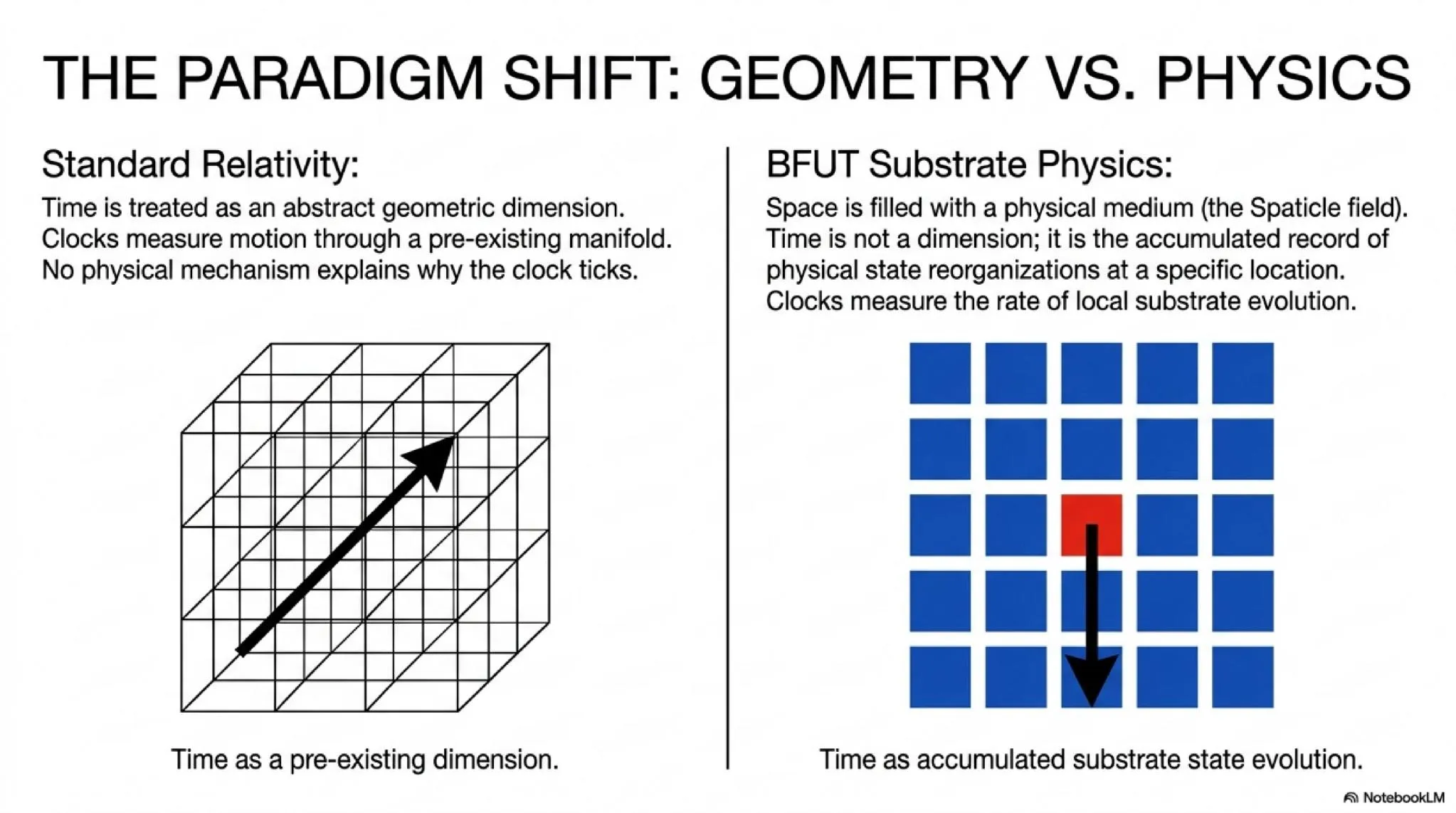
The central claim is that time is not a pre-existing dimension or manifold. Time is the accumulated record of substrate state evolution at a given location. Both kinematic and gravitational time dilation arise because the finite propagation capacity of the substrate must be allocated between spatial traversal and internal evolution. When more capacity is committed to spatial motion or to maintaining a deformed substrate configuration, less remains available for the internal processes that constitute clock rates.
The BFUT framework identifies the physical matter substrate that the author names the Spaticle field. This matter substrate corresponds physically to what general relativity describes geometrically as spacetime. It has an intrinsic equilibrium density of ρₛ = 7.3 × 10⁻²⁷ kg/m³, established by the particle-sector derivation in BFUT P16 [17]. This density anchors the temporal and propagation relations developed in the present paper. The Spaticle field is not an abstract mathematical convenience. It is a physical medium with measurable properties.
The Spaticle field is not the luminiferous ether. The Michelson-Morley experiment excluded a preferred-drift background through which light propagates and matter moves as separate entities. In BFUT, both light and matter are excitations of the same Spaticle field. Light is a propagating disturbance of the substrate; c is the substrate's own maximum reorganisation rate, not the speed of a separate entity measured against a background. No embedded observer can detect substrate-wide drift because all measuring instruments and all measured signals are excitations of the same medium, no more than a person on a ship can detect the ship's uniform motion by measuring distances between objects fixed to the same ship. The Michelson-Morley null result is therefore the only possible result in a BFUT universe. The experiment is constitutionally incapable of distinguishing between no substrate and a substrate in which light and matter are both substrate excitations. The latter is the BFUT position. Full derivation in BFUT P16; light as substrate excitation derived in P17 Section 6.6 [18] and P19 Section 13, with the master validation suite in [20].
1.1 Symbols and Notation Used in This Paper
The following symbols are used throughout this paper. All values are from the BFUT Master Symbol Guide.
| Symbol | Definition | Value / Expression |
|---|---|---|
| Fundamental Spaticle Field Constants | Fundamental Spaticle field constants | Fundamental Spaticle field constants |
| ρₛ | Intrinsic equilibrium density of the Spaticle field | 7.3 × 10⁻²⁷ kg/m³ |
| Carrier Field Timescales and Lengths | Carrier field timescales and lengths | Carrier field timescales and lengths |
| τc | Carrier response / relaxation time | Local carrier response-time parameter |
| Lrlx | Substrate relaxation length | Lrlx = cτc |
| Lₛ | Equilibrium carrier response length | Lₛ = 1/μₛ = 2.47918135 × 10²⁶ m = 26.205 Gly |
| Shared Physical Constants | Shared physical constants | Shared physical constants |
| G | Gravitational constant | 6.674 × 10⁻¹¹ m³ kg⁻¹ s⁻² |
| c | Fundamental propagation speed / speed of light | 2.998 × 10⁸ m/s |
| Time and Propagation Budget Symbols | Time and propagation budget symbols | Time and propagation budget symbols |
| η | Propagation efficiency | η = √(1 − v²/c²) = 1/γ |
| γ | Lorentz factor | γ = 1/√(1 − v²/c²) |
| tsub | Accumulated substrate state evolution | tsub = ∫η dt |
| tcoord | Coordinate time used as the reference time parameter | Reference coordinate time in an undisturbed substrate region |
| vspatial | Spatial traversal component of propagation budget | vspatial² + vinternal² + vgrav² = c² |
| vinternal | Internal evolution component of propagation budget | vinternal² = c² − vspatial² − vgrav² |
| vgrav | Gravitational deformation-maintenance component of propagation budget | vgrav² = c²(2GM/rc²)f(r,Rd) |
| dτ/dt | Proper time rate | η = dτ/dt |
| cs | Local effective substrate propagation speed | η = cs/c0 |
| c0 | Vacuum substrate propagation speed | Undisturbed-vacuum value, numerically equal to c |
| f(r,Rd) | Finite deformation-domain factor | f(r,Rd) = 1 inside the active domain and 0 outside the domain boundary |
| Rd | Deformation-domain radius | Rd = [3M/(8πρₛ)]¹ᐟ³ |
| ηmin | Minimum propagation efficiency at the maximally compressed core surface | ηmin > 0 |
| ψ(x,t) | Quantum mechanical wavefunction | Phase exp(−iEt/ħ) accumulates through substrate reorganisation |
| ηN | Nordtvedt parameter | Empirical parameter constrained by Lunar Laser Ranging |
2. The Spaticle Substrate and Finite Propagation Capacity
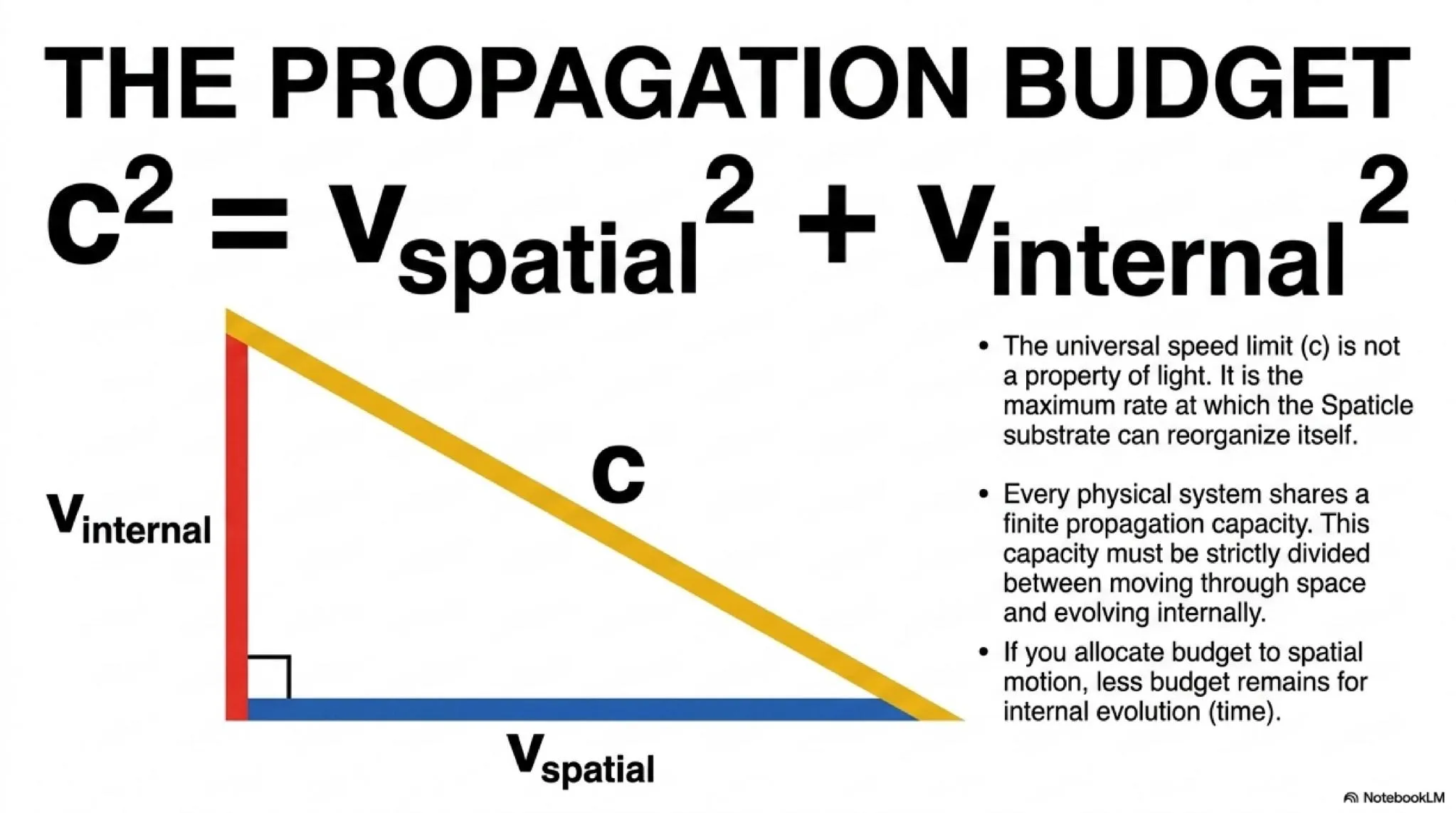
The Spaticle field is characterised by a finite propagation speed c determined by its equilibrium density ρₛ = 7.3 × 10⁻²⁷ kg/m³ and compressibility. This speed is the maximum rate at which the substrate itself can undergo causal reorganisation. Any physical process, particle motion, field propagation, or internal clock evolution, requires local substrate reorganisation and is therefore bounded by this rate.
At any location, the total propagation capacity available to the substrate can be expressed as a budget constraint:
c² = v²spatial + v²internal
Here vspatial represents the component of propagation committed to spatial traversal, and vinternal represents the component available for internal state evolution. This relation is not imposed geometrically but follows directly from the requirement that no causal process can exceed the substrate’s maximum reorganisation rate.
3. Time as Substrate State Evolution Length contraction follows from the same budget constraint through the geometry of simultaneity surfaces: the same efficiency factor η = √(1 − v²/c²) that governs time dilation also governs the spatial interval measured by a moving observer relative to a stationary one. Time dilation and length contraction are therefore not two effects but one, expressed in the time and space coordinates respectively.
Within the BFUT framework, time at a location is defined as the accumulated evolution of substrate states at that location. A clock does not measure an independently existing temporal dimension; it registers the net change in the physical configuration of the substrate with which it interacts. The proper time interval dτ between two events at the same location is proportional to the local substrate propagation efficiency η:
dτ = η dtcoord
where η = cs / c0 and cs is the local effective propagation speed determined by the substrate configuration. In undisturbed vacuum, η = 1. In regions where the substrate is compressed or deformed, cs < c0 and η < 1, so proper time accumulates more slowly relative to coordinate time measured in an undisturbed region.
4. Special-Relativistic Time Dilation from Propagation Budget Allocation
The total propagation capacity of the Spaticle substrate is limited by its equilibrium density ρₛ. At any location, this capacity is allocated between spatial traversal and internal state evolution according to the fundamental constraint (derived in BFUT P19 §7.2 from the finite reorganisation rate of the substrate):
c² = v²spatial + v²internal
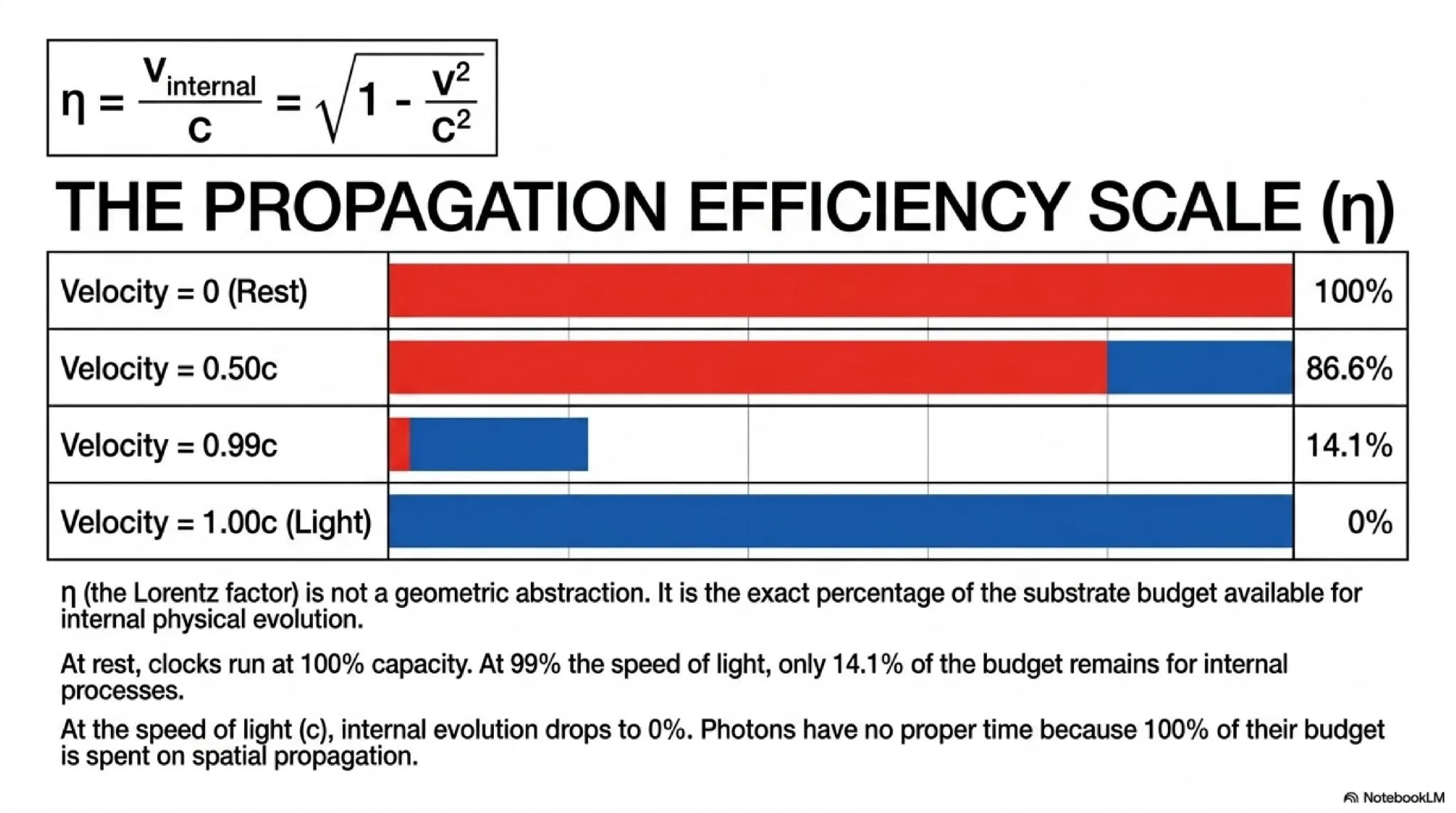
When a physical system moves at velocity v relative to a reference frame, a portion of the available propagation capacity must be committed to maintaining spatial displacement. The remaining capacity is available for internal processes. The propagation efficiency available for internal evolution is therefore:
η = √(1 − v²/c²)
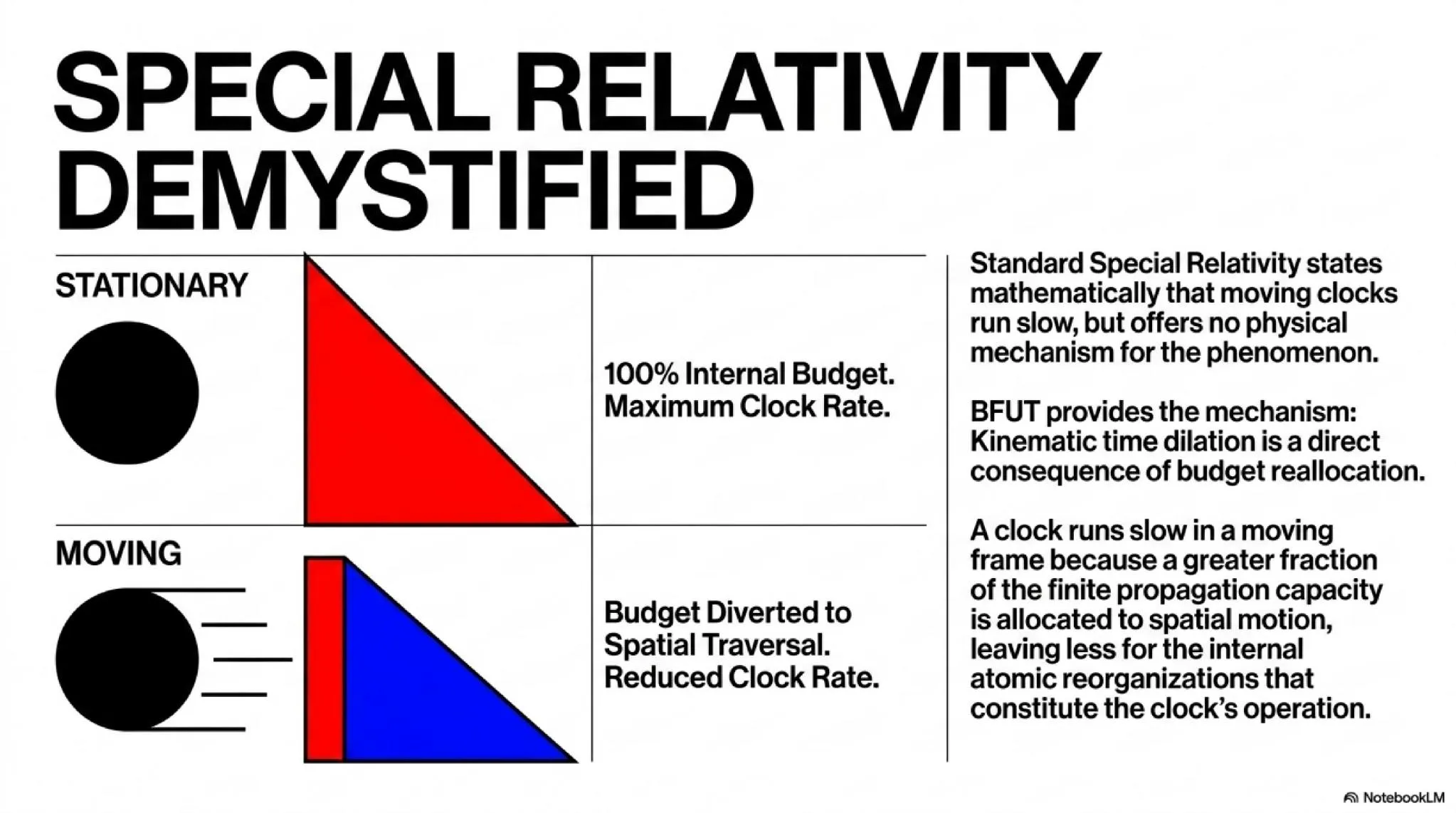
This factor is the inverse of the Lorentz factor of special relativity. It is the standard time-dilation factor, η = 1/γ = √(1 − v²/c²). A clock runs slow in a moving frame because a greater fraction of the finite propagation capacity is allocated to spatial motion, leaving correspondingly less for the internal reorganisations that constitute the clock's operation.
In the BFUT framework, time dilation arises because a larger fraction of the finite propagation budget is allocated to spatial motion, leaving less available for internal substrate evolution. The effect is relational: it is observed when comparing accumulated propagation histories along different paths through the substrate.
5. Gravitational Time Dilation and Finite Deformation Domains
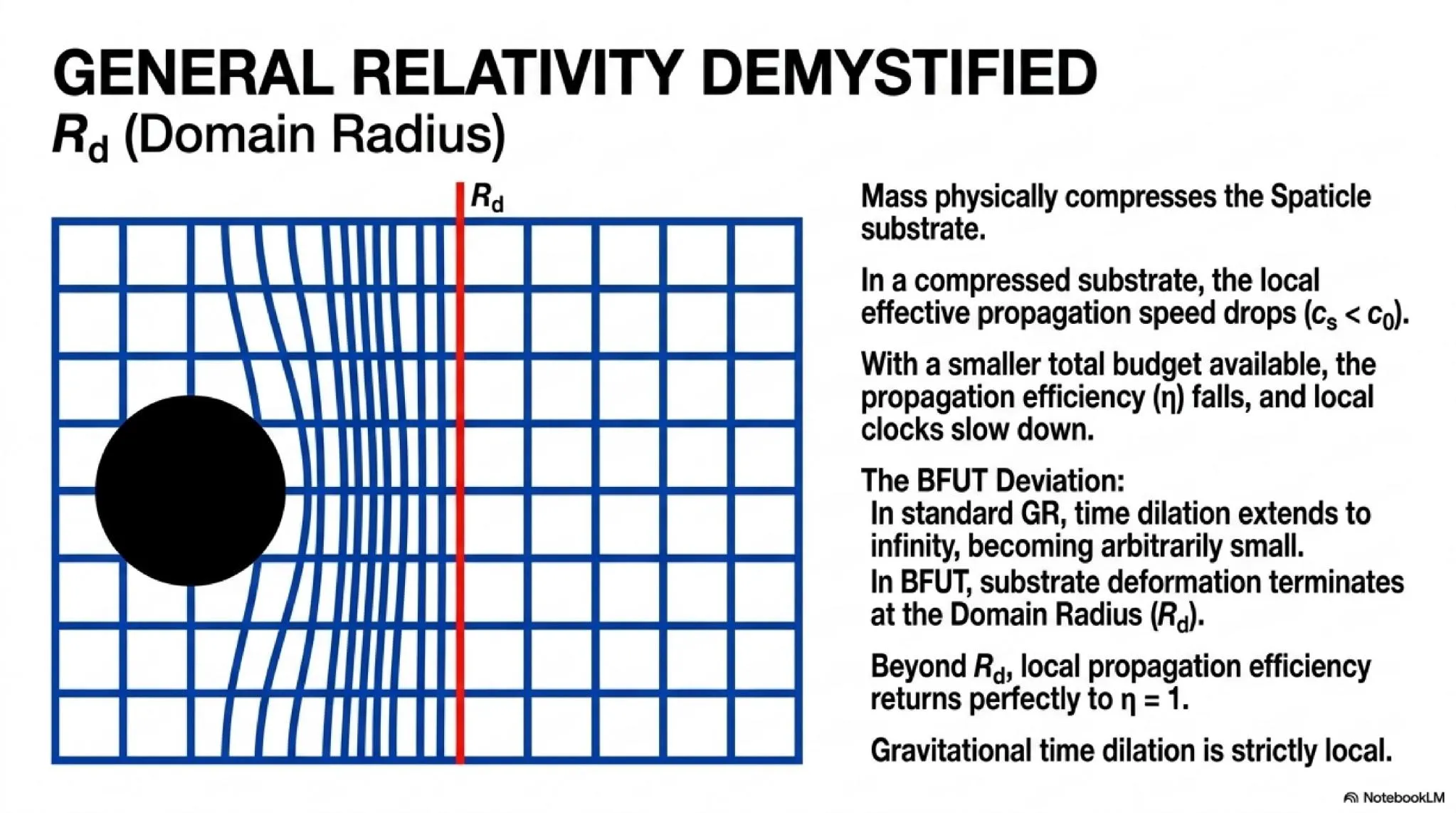
In the presence of mass-energy, the Spaticle substrate undergoes organised deformation. This deformation reduces the local propagation speed according to the field configuration. The gravitational time-dilation factor is governed by the local propagation efficiency η(x).
From the substrate field dynamics and the deformation-domain relation (DDR) established in BFUT P18, the local propagation efficiency in the weak-field regime near a mass M takes the form:
η(r) = √[1 − (2GM / r c²) · f(r, R_d)]
where the function f(r, Rd) encodes the finite-domain structure. The domain radius Rd is determined by DDR:
R_d = (3M / (8πρ_s))^(1/3)
Beyond Rd, the substrate deformation falls below the ambient fluctuation level and the local propagation efficiency returns to its vacuum value η = 1. Consequently, gravitational time dilation produced by a given mass terminates at the deformation domain boundary with a finite domain boundary as in standard general relativity.
This locality is a direct consequence of the non-zero equilibrium density ρₛ of the Spaticle substrate. The finite range is not an approximation but a structural feature of substrate relaxation dynamics.
6. Unification of Special and General Relativistic Time Dilation
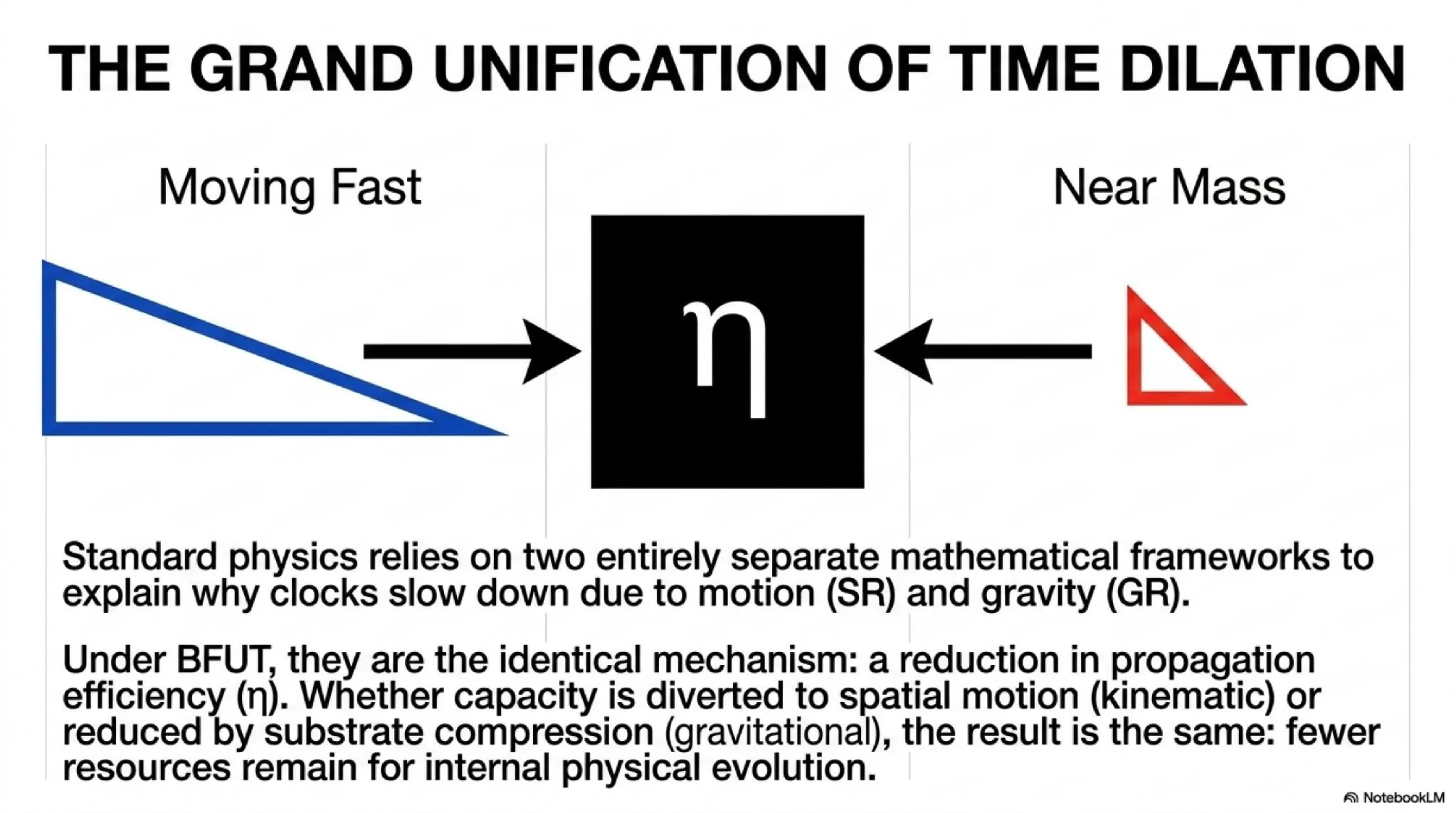
Both special-relativistic and gravitational time dilation arise from the same underlying physical mechanism: reduction in the propagation capacity available for internal substrate evolution.
In the kinematic case, capacity is diverted to spatial motion according to the constraint c² = v²spatial + v²internal. In the gravitational case, capacity is reduced because the substrate itself is deformed, lowering the local propagation speed c_s(r) according to the finite-domain structure established by the DDR formulation in BFUT P18.
In both situations, the proper time accumulated by any clock is determined by the fraction of propagation capacity that remains available for internal processes at that location. The mathematical structures of special and general relativity therefore emerge as different limiting cases of the same substrate propagation-budget accounting.
Within BFUT, both special-relativistic and gravitational time dilation arise from the same finite propagation-budget mechanism.
6.1 A Single Unified Propagation-Budget Formula for Time Dilation
Sections 4 and 5 derive special-relativistic and gravitational time dilation from applications of the propagation-budget constraint. To express both effects within a single formula, the propagation budget is written in three channels: spatial motion, gravitational deformation maintenance, and internal evolution, consistent with the combined time-dilation relation established in BFUT P18.
c² = v²internal + v²grav + v²spatial
Here vgrav is the component of propagation capacity committed to sustaining a locally deformed substrate configuration. Its relationship to the gravitational potential is made explicit by:
v²grav = c²·(2GM / rc²)·f(r, Rd)
so that the three-channel budget becomes:
c² = v²internal + c²·(2GM/rc²)·f(r,Rd) + v²spatial
Solving for the internal evolution capacity remaining after both gravitational deformation and spatial motion have drawn on the budget gives the unified propagation efficiency:
η = √[1 − v²/c² − (2GM / r c²)·f(r, Rd)]
so that the accumulated proper time is:
dτ = √[1 − v²/c² − (2GM / r c²)·f(r, Rd)] dt
This is the unified propagation-budget equation for time dilation in the BFUT framework. Setting the gravitational term to zero gives η = √(1 − v²/c²), the special-relativistic result derived in Section 4. Setting v = 0 gives η(r) = √[1 − (2GM/rc²)·f(r,Rd)], the gravitational result derived in Section 5. The same equation therefore describes both kinematic and gravitational time dilation as different manifestations of a single propagation-budget constraint.
This additive structure mirrors the standard weak-field result of general relativity for a clock in circular motion around a mass, dτ/dt = √[(1 − 2GM/rc²) − v²/c²], which is used operationally in satellite clock corrections. The propagation-budget framework offers a physical mechanism for that additive form: vspatial and vgrav draw on the same finite substrate reorganisation rate, so they compete for one shared capacity in the same way that two withdrawals draw down a single account.
This combination assumes vspatial and vgrav act as independent, non-interacting channels of the same budget, which holds in the weak-field, non-relativistic-velocity regime. The function f(r, Rd) as defined in Section 5 depends only on position (r, Rd) and on the source's mass and rotation, not on the velocity of the clock under consideration.
7. The Origin of the Universal Speed Limit c
The quantity c is not defined by the properties of light. It is the maximum rate at which the Spaticle substrate can propagate causal reorganisations. Massless excitations (photons, gravitational waves, and other freely propagating modes) have no requirement to maintain a localised condensation structure. Their entire energy budget is therefore available for propagation, and they travel at the substrate’s maximum rate. Massive particles must continuously sustain organised internal structure and therefore cannot allocate their full propagation capacity to spatial motion.
7.1 Photon Proper Time and Massless Propagation
The propagation-budget framework provides a direct physical explanation for a standard result of special relativity: photons accumulate zero proper time.
A photon is a massless excitation of the Spaticle substrate. It carries no requirement to maintain a localised condensation structure. Its internal evolution budget is zero because it has no internal structure to evolve. The full propagation capacity c is therefore available entirely for spatial traversal. Setting vinternal = 0 in the budget constraint c² = vspatial² + vinternal² gives vspatial = c exactly.
The proper time accumulated by a photon along any path is:
dτ = √(1 − vspatial²/c²) dt = √(1 − c²/c²) dt = 0
This is not a limiting case or a convention. It is a direct consequence of the propagation budget. A massless mode devotes 100% of its propagation capacity to spatial traversal and 0% to internal evolution. It therefore accumulates no proper time regardless of path length or coordinate duration. All photons, regardless of frequency or energy, share this property because masslessness means zero internal structure budget.
The same argument applies to gravitational waves and any other massless substrate excitation. The BFUT framework thus provides a physical mechanism for what standard relativity states mathematically: massless excitations travel along null geodesics and experience no proper time passage.
7.2 Time Begins When Substrate Evolution Begins
The identification of time with accumulated substrate state evolution has a direct implication for the question of time before matter organisation.
BFUT Paper 15 [11] establishes that the pre-luminous phase of the universe is characterised by a Spaticle substrate in statistical equilibrium, with gravitational sorting operating over unlimited time to produce the filament-node-void structure from which the first condensations emerge. In this phase the substrate exists but no organised condensations have yet formed.
Within the BFUT definition, physical time is the accumulated evolution of substrate states. The equilibrium substrate therefore undergoes physical evolution through thermal fluctuations and statistical variations. Operational clock time, however, requires an organised physical system whose internal evolution can be referenced and measured. Such a clock first becomes possible once a stable organised condensation forms. Before that stage there is substrate evolution, but no physical clock with which elapsed time can be operationally registered.
Thus, the statement that time begins when substrate evolution begins refers to the physical definition of time as accumulated substrate evolution, not to the creation of the Spaticle substrate itself. The substrate has always existed in the infinite BFUT universe, while operational clock time begins when an organised substrate structure capable of supporting a measurable clock process comes into existence.
This is the physical content that standard SR states mathematically. No speed beyond c is achievable because c is the hard propagation limit of the substrate, and at v = c the entire budget is consumed by spatial traversal, leaving η = 0 for both internal evolution and spatial measurement. The twin paradox, resolved in standard SR by path length in spacetime, is resolved here by accumulated substrate-evolution budget: the travelling twin commits more budget to spatial traversal and less to internal evolution, returning physically younger.
The same propagation-efficiency factor η = √(1 − v²/c²) governs both time dilation and length contraction because both arise from the same propagation-budget constraint c² = v²internal + v²spatial. Time dilation is η applied to the time coordinate; length contraction is η applied to the spatial coordinate along the direction of motion.
Length contraction arises from the same allocation through the geometry of simultaneity surfaces. An observer in motion through the substrate has simultaneity surfaces tilted relative to a stationary observer. When each observer measures the spatial extent of the same object by identifying its endpoints simultaneously in their own frame, they are sampling different substrate configurations at different moments as defined by the other observer. The spatial interval they each measure differs by the factor √(1 − v²/c²), the same efficiency factor η. No physical compression of the object occurs. Every atom in the object has locally invariant dimensions in its own substrate frame. The contracted length is a direct consequence of comparing propagation histories across differently-oriented simultaneity surfaces, exactly as the slowed clock rate is a consequence of the same budget allocation.
Time dilation arises because a moving system commits propagation capacity to spatial traversal, reducing the capacity available for internal state evolution. η = √(1 − v²/c²) is the fraction of the budget remaining for internal evolution.
In the BFUT framework this result follows directly from the same propagation-budget constraint already established in Section 4: c² = v²spatial + v²internal. Time dilation and length contraction are not two independent relativistic effects. They are two aspects of the same budget allocation.
Standard special relativity predicts that a body in motion contracts along its direction of motion by the factor √(1−v²/c²). Even in standard SR this is a relational measurement effect between frames, not a physical compression felt by the moving observer. The moving observer finds their own dimensions perfectly normal. No experiment demonstrates intrinsic physical compression of matter independent of the observer-comparison framework. The observable consequences attributed to Lorentz contraction, muon lifetimes, relativistic heavy-ion cross-sections, are relational measurements consistent with a path-comparison interpretation without requiring physical compression of atoms.
7.3 Lorentz Contraction as Substrate-Traversal Geometry
8. The Arrow of Time
The substrate propagates disturbances outward from their sources. This outward propagation is irreversible at the level of the medium: a disturbance once emitted cannot be locally recalled. The thermodynamic arrow of time is the macroscopic expression of this microscopic irreversibility (Boltzmann 1896 [1]; see also Price 1996 [9] for philosophical discussion). Entropy increase reflects the spreading of substrate disturbances that cannot be reversed by local operations. The past corresponds to configurations that have already propagated their influence outward; the future corresponds to configurations that have not yet done so.
9. Analysis of Common Philosophical Expressions Involving Time
Several philosophical statements about time are frequently encountered in both popular and technical literature. This section evaluates them against the technical structure developed above.
9.1 “Time is an illusion”
Within BFUT this statement is imprecise. Time corresponds to a real physical process: the accumulation of substrate state changes. What is illusory is the notion of time as an independently existing dimension through which events move. The process itself is physical and measurable.
9.2 “The passage of time is subjective”
The rate at which substrate evolution occurs at a given location is objective and determined by the local propagation efficiency. Different observers measure different rates when comparing clocks across different substrate configurations, but each local rate is physically well-defined.
9.3 “The block universe is the correct ontology”
The block-universe picture treats all times as equally real within a static four-dimensional manifold (see, e.g., Minkowski 1908 [8]; modern discussions in Price 1996 [9] and Maudlin 2007 [7]). BFUT rejects this ontology. Only the current substrate configuration exists. Past configurations have already propagated their effects outward; future configurations have not yet been realised. The mathematical convenience of a block description does not imply ontological reality.
9.4 “Time flows”
The metaphor of flow is misleading if it suggests motion through a pre-existing temporal dimension. A more accurate description is that organised physical change accumulates at a rate determined by local substrate conditions. There is no additional entity called “time” that flows.
10. Why Clocks Measure Time
A clock is any physical system whose internal evolution depends on substrate state changes. Atomic clocks rely on electron transitions, mechanical clocks on periodic mechanical motion, and biological clocks on metabolic and neural processes. In all cases, the measurable rate is determined by how rapidly the relevant substrate configurations can evolve under local conditions. A clock does not measure an external temporal flow; it registers the net accumulation of substrate reorganisations within its own structure. Different clocks (atomic, mechanical, biological) accumulate proper time at different rates if they couple to the substrate through different internal processes, but all ultimately reflect the same underlying propagation efficiency.
10.1 Why All Clock Types Agree
The substrate propagation framework predicts that all physical clocks, regardless of their mechanism, must agree on proper time intervals when compared under identical substrate conditions. This is a non-trivial prediction because different clock types couple to the substrate through entirely different physical mechanisms.
Atomic clocks measure electron transition frequencies. The transition rate depends on the local electromagnetic coupling strength, which is determined by the substrate density ρₛ through the fine structure constant (BFUT Paper 19). When the substrate propagation efficiency η falls, the transition rate falls proportionally.
Pulsar timing measures the rotational period of a neutron star. The period is determined by the rotational mechanics of a condensed object embedded in the substrate. The substrate propagation efficiency η governs all local physical rates including rotational dynamics.
Radioactive decay measures the rate of nuclear rearrangement. The decay constant depends on the strong and weak coupling strengths, both of which are derived from ρₛ (BFUT Papers 17 and 19). A reduction in propagation efficiency reduces these rates proportionally.
Biological clocks measure metabolic and neural process rates. These depend on chemical reaction rates, molecular vibration frequencies, and diffusion rates, all of which are substrate evolution rates and all governed by the same propagation efficiency η.
The reason all clocks agree is that they are all measuring the same underlying quantity: the local substrate propagation efficiency η at their location. Different mechanisms access the same substrate property through different physical channels. When gravitational or kinematic time dilation reduces η, every physical rate at that location slows by the same factor. No clock type is privileged. The universality of time dilation is a direct consequence of the universality of the substrate propagation budget.
11. Simultaneity from Substrate Propagation Delays
In special relativity, absolute simultaneity is lost because the finite propagation speed of light makes simultaneity frame-dependent. Within BFUT this has a direct physical interpretation: an observer assigns simultaneity using a synchronization procedure based on finite-speed signal propagation, while observers in relative motion or in different gravitational configurations have different propagation histories and synchronization relations. Simultaneity is therefore not a global absolute property but a frame-dependent relation arising from finite substrate propagation. The relativity of simultaneity follows from the finite propagation capacity of the substrate.
12. Causality from Finite Reorganisation Rates
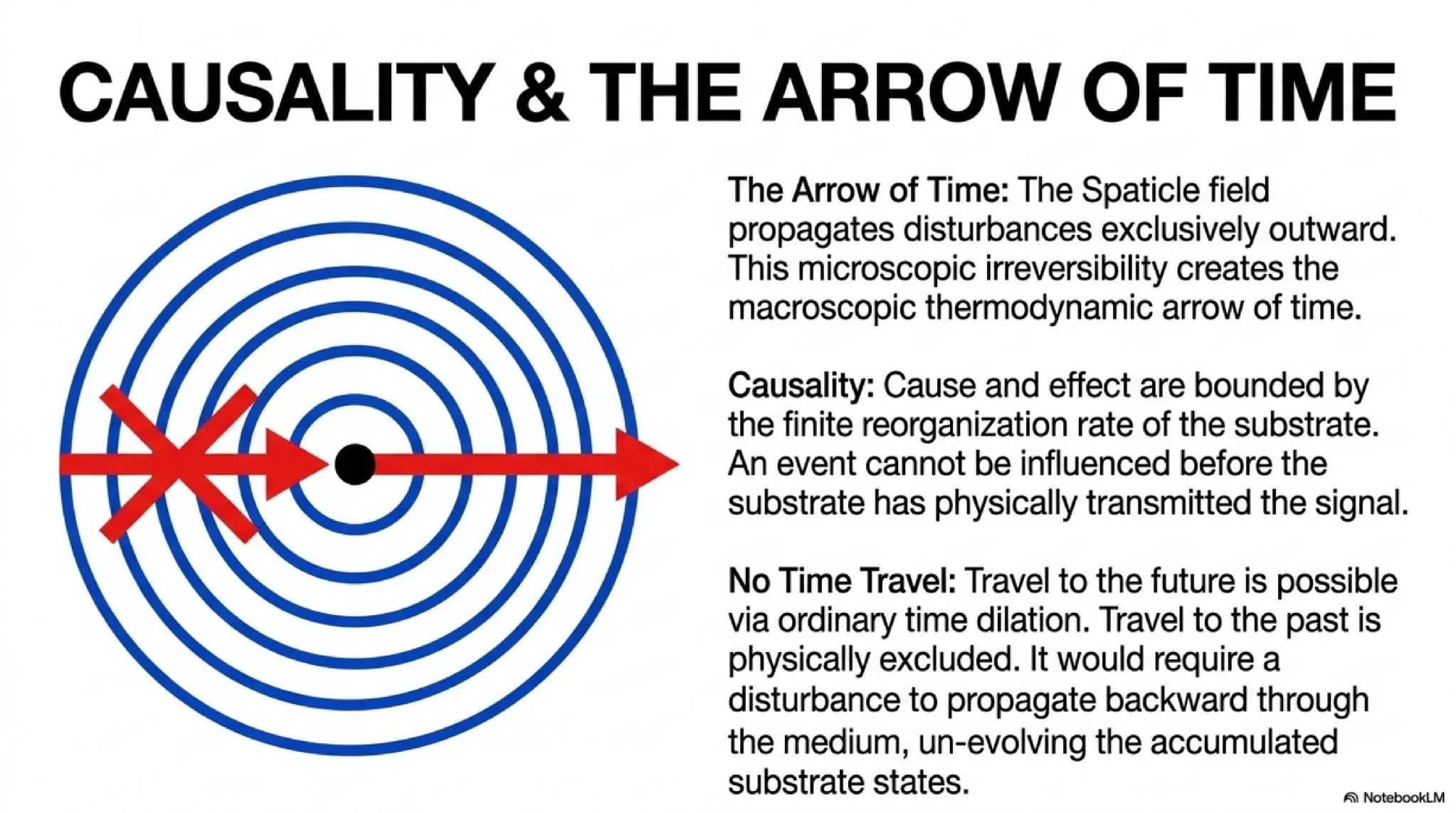
Causality is often treated as a postulate. In BFUT it follows directly from the finite rate at which the substrate can reorganise. For event A to influence event B, a disturbance must propagate from A to B through the substrate. This propagation requires a non-zero time determined by the distance and the local propagation efficiency. No influence can arrive before the substrate has had time to reorganise and carry the disturbance. The causal structure of spacetime therefore emerges from the requirement that substrate reorganisation takes finite time. Closed timelike curves would require a disturbance to return to its origin before the substrate has completed the necessary reorganisations, which violates the propagation limit.
13. Why the Past Cannot Be Changed
Once a substrate disturbance has propagated outward from its source, the information it carries is distributed across an expanding region of the substrate. Reversing the past would require recalling or cancelling all those distributed disturbances simultaneously. Because the substrate propagates disturbances outward at finite speed and without a mechanism for local reversal, no local operation can undo the global propagation that has already occurred. The past is therefore fixed not by metaphysical necessity but by the irreversible spreading of substrate disturbances.
14. Why the Future Does Not Yet Exist
Future states correspond to substrate configurations that have not yet been realised through local reorganisation. Until the substrate at a given location has undergone the sequence of changes that constitute a particular configuration, that configuration has no physical existence. The future is potential and not yet actual. Treating future events as already existing in a four-dimensional manifold misrepresents the ontological status of unrealised substrate states. The block-universe picture may be mathematically convenient but does not correspond to the physical process of substrate evolution.
15. Time Travel in the BFUT Framework
Travel to the future via time dilation is possible in principle. An observer who allocates a larger fraction of propagation capacity to spatial motion or who remains in a region of reduced propagation efficiency will accumulate less proper time than observers in less affected regions. Upon return, the traveller will have aged less. This is ordinary time dilation, not exotic time travel.
Travel to the past is not possible. It would require a disturbance to propagate backward through the substrate or to return to its origin before the necessary reorganisations have occurred. Both possibilities violate the outward, irreversible character of substrate propagation. Closed timelike curves are likewise forbidden because they would require information to arrive at an event before the substrate has had time to carry it (Gödel 1949 [5]; Hawking 1992 chronology protection conjecture [6]). Grandfather paradoxes and information paradoxes do not arise because backward causation through the substrate is physically excluded.
15.1 Singularity Impossibility from the Time Framework
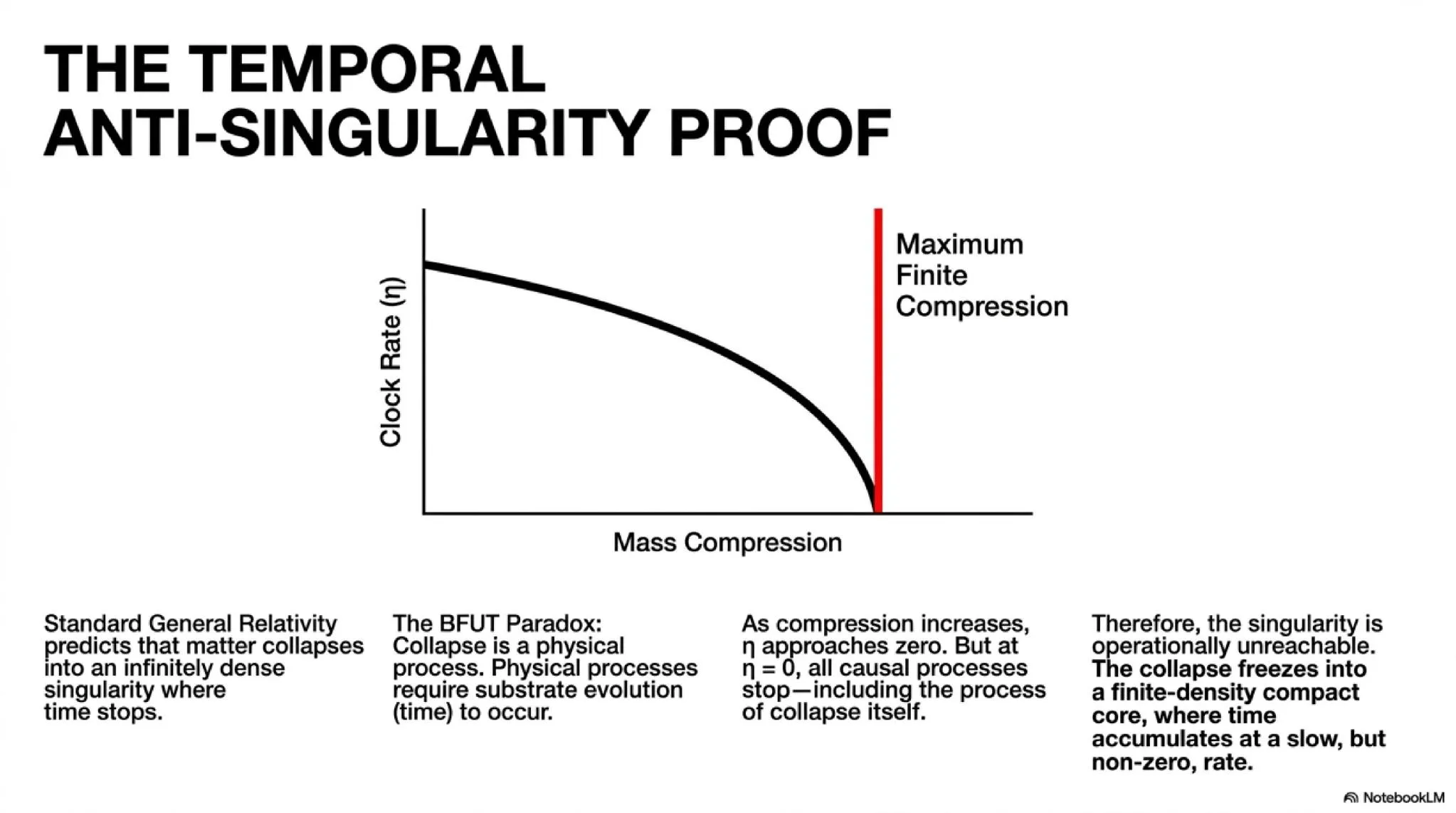
The identification of time with accumulated substrate evolution leads to a temporal proof that true gravitational singularities cannot exist.
A true singularity requires infinite compression of the substrate at a point. Infinite compression means infinite substrate density at that point. But the local propagation efficiency η = cs/c0 falls as the substrate becomes denser and more deformed. At infinite compression, η approaches zero. When η = 0, the rate of substrate state evolution at that location is zero. No substrate state changes can occur. No physical process can proceed. The accumulation of proper time at that location ceases entirely.
A location where proper time accumulation has ceased is not a physical location in any operational sense. No clock can run there. No causal process can occur there. No substrate reorganisation can happen there. The mechanism that constitutes time has been destroyed by the very compression that was supposed to produce the singularity.
The singularity is therefore temporally self-defeating: the process of forming it destroys the physical basis for any further evolution. Before infinite compression is reached, the substrate resistance to further compression, through the restoring pressure and coherence threshold mechanisms derived in BFUT Paper 26 [16], stabilises the collapse into a finite-density compact structure. Time continues to accumulate at a slow but non-zero rate within that structure.
This temporal argument is independent of and complementary to the dynamical anti-singularity argument of BFUT Paper 26. The dynamical argument shows that the substrate restoring pressure prevents infinite compression. The temporal argument shows that even if infinite compression were approached, time would cease before it was reached, making the singularity operationally unreachable.
15.2 Quantum Time and Wavefunction Evolution
Quantum mechanical wavefunction evolution has an immediate interpretation within the substrate time framework.
The wavefunction ψ(x,t) describes the substrate configuration of a quantum system. The Schrödinger equation governs how this configuration evolves. BFUT Paper 19A [13] derives the Schrödinger equation from substrate propagation dynamics: the wavefunction phase evolution is the accumulated substrate state change of the system over time.
Within this framework, quantum time is substrate evolution time. The phase exp(−iEt/ħ) accumulates because the substrate configuration of the system is continuously reorganising at a rate proportional to its energy. Higher energy means faster substrate reorganisation means faster phase accumulation.
Quantum time dilation follows automatically. When the propagation efficiency η falls due to gravitational deformation or kinematic allocation, the rate of substrate reorganisation falls for all processes including quantum phase evolution. The Schrödinger equation in a gravitationally deformed substrate picks up the local η factor. Quantum clocks dilate for exactly the same reason classical clocks dilate.
The quantum Zeno effect, the slowing of evolution under frequent measurement, also has a substrate interpretation: measurement is a substrate interaction that partially allocates the system's propagation budget to the coupling event, temporarily reducing the budget available for independent internal evolution.
15.3 Consciousness and Subjective Time
The substrate framework provides a physical basis for the distinction between objective and subjective time.
Objective time is the accumulated substrate evolution at a location, measured by any physical clock. This is uniquely defined by the local propagation efficiency η and is the same for all physical clocks at that location.
Subjective time is the rate at which a conscious system processes its internal substrate evolution. BFUT Papers 20 and 21 (DOI: 10.5281/zenodo.19992457 and DOI: 10.5281/zenodo.20025739) develop the Consciousness Index framework which quantifies how different levels of substrate organisation produce different capacities for information integration.
A highly conscious system with many active integration channels processes more substrate evolution per unit objective time and therefore experiences subjective time as passing more richly. A system with fewer integration channels, under anaesthesia, in deep sleep, or in states of reduced metabolic activity, processes less substrate evolution per unit objective time. Subjective time slows or stops while objective time continues.
The variability of subjective time therefore does not contradict the objectivity of substrate evolution time. It reflects the varying capacity of different conscious organisations to sample and integrate the objective substrate evolution that is occurring around them.
16. Predictions and Observational Consequences
The framework predicts that gravitational time dilation produced by a given mass terminates at the deformation domain boundary with a finite domain boundary. This implies observable deviations from standard general-relativistic predictions in precision timing experiments conducted across domain boundaries, particularly in pulsar timing arrays and future deep-space clock comparisons. Carrier relaxation signatures in gravitational-wave data following compact-object mergers provide an independent channel for testing the underlying substrate relaxation dynamics.
16.1 Time-Dilation Saturation
The combination of finite deformation domains (DDR, BFUT Paper 18) and finite maximum compression (BFUT Paper 26) produces a prediction with no analogue in standard general relativity: gravitational time dilation must possess a finite maximum.
In standard GR, the Schwarzschild-coordinate time assigned by a distant observer to an object approaching the event horizon becomes increasingly dilated, with the corresponding coordinate rate approaching zero at the horizon. This coordinate effect does not mean that proper time ceases for the freely falling object at the horizon. The singularity is a separate interior feature of the classical solution, associated with divergent curvature and geodesic incompleteness.
In BFUT, two independent mechanisms prevent the divergence associated with the classical singularity. First, the substrate never reaches infinite compression because the restoring pressure and coherence threshold mechanisms of Paper 26 stabilise collapse at a finite density. Second, gravitational time dilation terminates at the DDR domain boundary Rd, as defined by the DDR formulation established in BFUT P18, beyond which η returns to its vacuum value.
The maximum achievable time dilation for any physical compact object is therefore the dilation at the surface of the maximally compressed finite-density core. This is large but finite. It corresponds to a very small but non-zero propagation efficiency ηmin > 0 at the core surface.
This prediction is observationally testable. Precision timing experiments near compact objects should show time dilation approaching but never reaching zero. The characteristic relaxation signatures in gravitational-wave data following compact-object mergers provide a channel for testing the finite-maximum constraint.
17. Unification of Time, Time Dilation, Length Contraction, Speed of Light, and Speed of Gravity
Time, light, and gravitational waves share a single physical origin in BFUT. Time is the accumulated evolution of substrate states: a clock measures the amount of physical substrate evolution occurring within its own structure, not the passage of an independent temporal dimension. The local rate at which time accumulates is therefore set by the local propagation efficiency of the substrate:
η = dτ/dt = cs/c0
where η is the local substrate propagation efficiency, dτ is local proper time, dt is coordinate time in an undisturbed substrate region, cs is the local effective propagation speed, and c0 is the vacuum propagation speed [10]. This single quantity, η, governs every process that depends on substrate reorganisation: atomic transitions, nuclear processes, mechanical processes, and biological processes all slow together under reduced η, because all are measuring the same underlying substrate propagation efficiency [10]. Photons and gravitational waves are both organised propagating disturbances of the same Spaticle substrate, and both are massless: no rest-mass condensation diverts any part of their propagation budget into internal maintenance, so the entirety of their propagation capability is available for travel, and both propagate at c0.
Relativistic time dilation follows from the same propagation budget shared between spatial motion and internal evolution:
c² = vspatial² + vinternal²
giving η = √(1 - v²/c²), the Lorentz factor, derived here as a substrate propagation-budget result instead of a geometric postulate [10]. Gravitational time dilation follows from the same mechanism: mass-energy deforms the substrate, reducing local propagation efficiency η, and this single reduction lowers local clock rates and local propagation speeds together, by the same factor [10, 12]. Causality follows directly: because the substrate has a finite maximum reorganisation rate c_0, no causal influence propagates faster than that rate, and causal order is a direct consequence of finite substrate propagation capability instead of a separate postulate [10].
18. The Equivalence Principle in BFUT
BFUT reproduces the same curvature-matter coupling as general relativity: a given local stress-energy configuration deforms the Spaticle field in the same geometric relationship that general relativity attributes to abstract spacetime curvature. Test particles therefore follow the same trajectories in both frameworks for the same source. This gives BFUT the Weak Equivalence Principle by direct inheritance: acceleration in a gravitational field is independent of an object's composition, because it depends only on the geometry produced by the source, not on the internal structure of the falling body.
The Einstein Equivalence Principle's clock-universality requirement is likewise satisfied, and satisfied more directly than in general relativity. Section 17 already establishes that atomic, nuclear, mechanical, and biological processes all slow together under the same local propagation efficiency η, because every physical process is ultimately a substrate reorganisation governed by the same underlying rate. Local position invariance, the requirement that all clocks agree on how much a given field configuration slows them, is therefore a structural feature of BFUT as a structural consequence.
The Strong Equivalence Principle stands on different footing. General relativity is a pure metric theory: curvature is the gravitational degree of freedom in the theory. BFUT instead treats the Spaticle field as a physical substrate with its own equilibrium density ρₛ, finite response and relaxation properties, and finite deformation domain Rd. The substrate therefore contributes physical structure beyond the metric response itself, providing the framework within which strong-equivalence effects can be examined.
A self-gravitating body's own binding energy is stored as Spaticle deformation energy. Whether that stored deformation energy couples back to the ambient field with exactly the same strength as ordinary rest-mass and kinetic energy is determined by the substrate equation of state and coupling dynamics. A difference in that coupling would produce a Nordtvedt-type effect, namely a difference between the free-fall trajectory of a self-gravitating body and that of a test particle. The quantitative magnitude of such an effect follows once the coupling between binding energy and ρₛ is obtained from the substrate field dynamics (F1-cov). Existing Lunar Laser Ranging measurements provide the corresponding empirical constraint on the Nordtvedt parameter ηN.
In summary: the Weak and Einstein Equivalence Principles hold in BFUT as the corresponding local limits of the substrate framework. The Strong Equivalence Principle is not imposed as a fundamental assumption. BFUT's identification of gravity with a physical substrate possessing its own density, response and relaxation properties, and finite deformation range, provides a distinct framework for examining strong-equivalence effects and their possible Nordtvedt-type signatures.
19. Conclusion
This paper develops the temporal structure of the BFUT framework by applying the propagation-budget principle together with the established BFUT relations developed in Papers 18, 19, 20, 21, and 26. The central constraint is c² = v²internal + v²grav + v²spatial, representing the propagation budget shared between internal evolution, gravitational deformation maintenance, and spatial motion. Special-relativistic and gravitational time dilation, and their unified formula, follow from this allocation. Length contraction follows from the same efficiency factor η applied to the spatial coordinate. The arrow of time follows from the irreversibility of outward substrate propagation. The twin paradox is resolved by the objective difference in propagation budget allocated to spatial traversal along each path. Photon proper time is zero because a massless excitation commits the entire budget to spatial propagation. All physical clocks agree on elapsed proper time because all internal processes depend on the same substrate evolution rate. Simultaneity and causality follow from finite substrate propagation speed. The past is fixed because propagated disturbances cannot be locally recalled; the future is unrealised because the substrate has not yet completed the reorganisations that will constitute it. A gravitational singularity is physically unreachable because the finite-density and temporal limits of the substrate prevent infinite compression. Quantum wavefunction evolution is substrate evolution time. The Weak and Einstein Equivalence Principles hold within the framework; the Strong Equivalence Principle is not imposed, with strong-equivalence effects providing a further observational domain for the theory.
Two interactive simulations accompany this paper. The first covers SR kinematic time dilation and gravitational time dilation with the Rd domain cutoff from BFUT P18. The second covers photon proper time and the propagation budget c² = vspatial² + vinternal², universality of clock agreement, the temporal proof of singularity impossibility, and quantum and subjective time through the Consciousness Index of BFUT P20 [14] and P21 [15]. Both are available in the BFUT companion simulations code deposit [19] (DOI: 10.5281/zenodo.20554084).
References
[1] Boltzmann, L. (1896). Vorlesungen über Gastheorie. Leipzig: Barth.
[2] Einstein, A. (1905). Zur Elektrodynamik bewegter Körper. Annalen der Physik, 17, 891-921.
[3] Einstein, A. (1915). Die Feldgleichungen der Gravitation. Sitzungsberichte der Preussischen Akademie der Wissenschaften, 844-847.
[4] Einstein, A. (1916). Die Grundlage der allgemeinen Relativitätstheorie. Annalen der Physik, 49, 769-822.
[5] Gödel, K. (1949). An example of a new type of cosmological solutions of Einstein’s field equations of gravitation. Reviews of Modern Physics, 21, 447-450.
[6] Hawking, S. W. (1992). Chronology protection conjecture. Physical Review D, 46, 603-611.
[7] Maudlin, T. (2007). The Metaphysics Within Physics. Oxford University Press.
[8] Minkowski, H. (1908). Raum und Zeit. Jahresbericht der Deutschen Mathematiker-Vereinigung, 75-88.
[9] Price, H. (1996). Time’s Arrow and Archimedes’ Point. Oxford University Press.
[10] Sharma, V. S. (2026). Unification of Particle Physics: Deriving Fine Structure and Coupling Constants, W, Z, and Higgs Boson Masses, Redefining and Unifying Gravity and Time. BFUT Paper 19. Zenodo. DOI: 10.5281/zenodo.20145567.
[11] Sharma, V. S. (2026). What Existed Before Matter and the Spaticle Field: The Origin of Space, Time, and the Physical Substrate of Reality in an Infinite Universe. BFUT P15. Zenodo. DOI: 10.5281/zenodo.19811691.
[12] Sharma, V. S. (2026). Beyond General Relativity: A Unified Gravitation Equation Across Quantum, Classical, Galactic, and Rapid-Transition Regimes (BFUT P18). Zenodo. DOI: 10.5281/zenodo.20145506.
[13] Sharma, V. S. (2026). Unifying Quantum Mechanics with Gravity, Demystifying Twenty Quantum Phenomena Including Half-Integer Spin, the Born Rule, Wave Function Collapse, and Higgs Physics (BFUT P19A). Zenodo. DOI: 10.5281/zenodo.20145695.
[14] Sharma, V. S. (2026). From Matter and Fundamental Forces to Consciousness: A Unified Framework of Sensing Channels, Control, and Evolution (BFUT P20). Zenodo. DOI: 10.5281/zenodo.19992457.
[15] Sharma, V. S. (2026). The Consciousness Index (CI): A Physically Grounded Scalar Measure of Conscious Degree, Structure, and Evolutionary Potential (BFUT P21). Zenodo. DOI: 10.5281/zenodo.20025739.
[16] Sharma, V. S. (2026). Singularity: Why and How Physical Substrate Dynamics Make Infinite Density Impossible. BFUT P26. Zenodo. DOI: 10.5281/zenodo.20557070.
[17] Sharma, V. S. (2026). The Origin of Matter, Antimatter, and Fundamental Forces: How Protons, Electrons, and Hydrogen FormeD P16. Zenodo. DOI: 10.5281/zenodo.19908215.
[18] Sharma, V. S. (2026). The Emergence of Forces and Fundamental Senses: How the Spaticle Field Gave Rise to Gravity and All Other Forces. BFUT P17. Zenodo. DOI: 10.5281/zenodo.19976408.
[19] Sharma, V. S. (2026). Companion Simulations: Substrate Physics Visualised. Zenodo. DOI: 10.5281/zenodo.20554084
[20] Sharma, V. S. (2026). BFUT P17-18-19-22 Master Validation Suite. Zenodo. DOI: 10.5281/zenodo.20156714