
BFUT P27
The Planck Constant: A First-Principles Derivation of ħ and How It Reshapes the Interpretation of Quantum Mechanics
Vijay Shankar Sharma
Independent Researcher, Gurugram, National Capital Region, India
ORCID: 0009-0001-9622-6121
DOI: 10.5281/zenodo.20620283
The author declares no conflict of interest and no funding was received for this research.
License: CC BY-NC-ND 4.0
Abstract
The Big Flare-Up Theory (BFUT) treats the reduced Planck constant as a derived particle-sector quantity rather than a primitive postulate. Using the condensation minimum R₀ = 1.27348221 from BFUT P16, the measured proton charge radius rₚ = 0.8414 fm, and the proton mass mₚ, the theory gives ħ_vss = mₚcrₚ/(πR₀) = 1.054577 × 10⁻³⁴ J·s, differing from the reference value by 0.00048%. This paper traces the consequences of that substitution through action quantisation, Compton and de Broglie wavelengths, the uncertainty relation, tunnelling, the harmonic oscillator, angular momentum, the Schrödinger kinetic operator, quantum-gate phase evolution, and the Planck units. It also aligns the fine-structure-constant relation with BFUT P19: α_vss = e²R₀/(4ε₀mₚc²rₚ) = 1/137.036655 is the electromagnetic form of the same P16 condensation identity, not an independent derivation. The paper therefore distinguishes algebraic rewrites and consistency relations from independent predictions. For vacuum energy, it adopts the P16/P19 separation between the proposed corrected empty-mode QFT sum, which is zero, and the separately derived Spaticle-substrate rest-energy density uₛ = ρₛc² = 6.5635567 × 10⁻¹⁰ J/m³ for ρₛ = 7.30 × 10⁻²⁷ kg/m³. Within BFUT, ħ is consequently interpreted as the action scale associated with the proton-anchored condensation geometry, while the standard quantum formulas retain their other physical inputs and domains of validity.
Keywords: Planck constant; condensation geometry; Compton wavelength; de Broglie wavelength; uncertainty principle; quantum tunnelling; harmonic oscillator; angular momentum; spin-statistics theorem; Planck units; fine structure constant; vacuum energy; action quantisation; Spaticle substrate; BFUT
1. Introduction
BFUT identifies the physical fabric of space as the Spaticle field, with equilibrium density ρₛ = 7.3 × 10⁻²⁷ kg/m³ derived in the particle-sector chain. Across the BFUT programme, particle, gravitational, quantum, and cosmological results share the same substrate ontology while retaining their actual derivational inputs.
The reduced Planck constant ħ appears in every formula of quantum mechanics. Standard physics inserts it by postulate and offers no explanation for its numerical value. P16 Section 5.2 [3] derives ħ from condensation geometry: ħ = mp·c·rp/(π·R₀). The quantum of action has its value because matter condenses at the scale set by the P16 free-energy functional.
If ħ has a geometric origin, every formula that contains ħ can be rewritten with the condensation expression ħ = mp · c · rp / (π · R₀). Other quantities in those formulas (p, m, V, E, ω) remain. This paper works through the principal formulas and states what the substitution means physically.
A note on provenance and agreement percentages used throughout. The P16 derivation uses the geometrically derived R₀ = 1.27348221 and the independently measured proton charge radius rₚ = 0.8414 fm (CODATA 2018), giving ħ_vss = 1.054577 × 10⁻³⁴ J·s, 0.00048% from the reference value ħ = 1.054571817 × 10⁻³⁴ J·s. Any purely algebraic rewrite containing ħ_vss inherits this action-scale offset only when all other quantities are held fixed. Planck units scale as ħ^(1/2) and therefore inherit approximately 0.00024%. Where BFUT-derived particle masses are also used, their mass differences must be included separately. The oscillator value E₀ = mₚc²/(2πR₀) is a worked BFUT example, not an independently measured prediction.
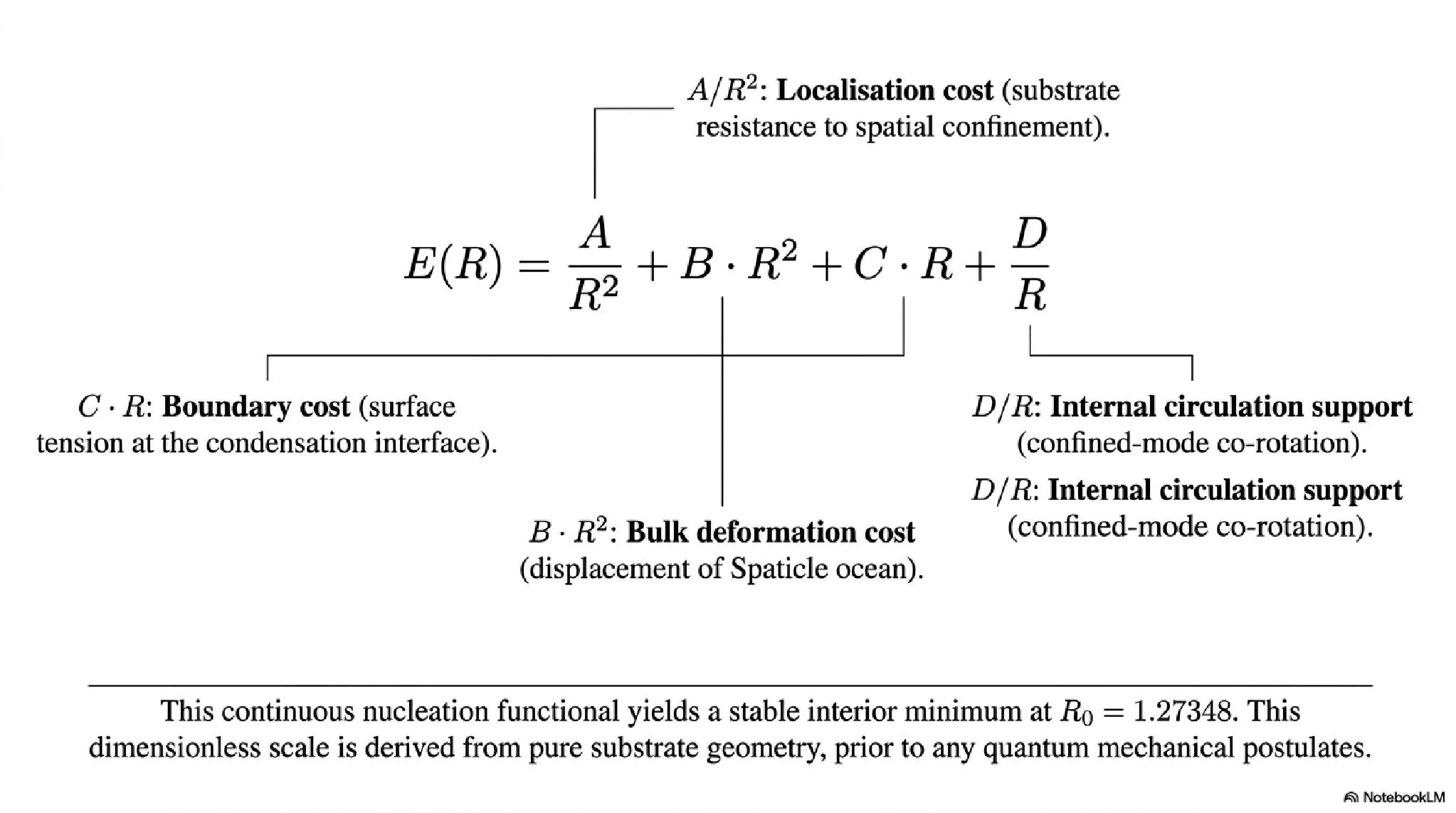
Figure 1. BFUT derivation chain for the reduced Planck constant from the P16 condensation geometry.
2. The BFUT Derivation of ħ from Condensation Geometry
The reduced Planck constant ħ appears in nearly every formula of quantum mechanics, yet standard theory offers no explanation for its numerical value. In the BFUT framework, ħ is not introduced as a postulate but derived as a computed output of substrate condensation geometry.
2.1 Step-by-Step Derivation
Step 1. The substrate density ρₛ. The equilibrium density of the Spaticle substrate is ρₛ = 7.3 × 10⁻²⁷ kg/m³, constrained independently from multiple sectors.
Step 2. The condensation functional. E(R) = A/R² + B R² + C R + D/R, with coefficients from P16 Appendix C: A = 1/2, B = 0.56308, C = −1/3, D = 1.
Step 3. Stable condensation scale. Minimising with respect to the dimensionless radius R gives the interior minimum R₀ = 1.27348.
Step 4. The physical condensation length. ℓ_model = rp / R₀ = 6.607 × 10⁻¹⁶ m.
Step 5. ħ_vss = mₚ · c · rₚ / (π · R₀). Substituting R₀ = 1.27348221, rₚ = 0.8414 fm (CODATA 2018), and the proton mass gives ħ_vss = 1.054577 × 10⁻³⁴ J·s, 0.00048% from the reference value.
2.2 Physical Interpretation
ħ is the action associated with one condensation-scale momentum quantum (mp · c) traversing one condensation-scale length (ℓ_model), divided by π. ħ has the value it does because matter condenses at the geometric scale fixed by the P16 free-energy functional.
2.3 Multiple Roles of R₀ in the BFUT Programme
R₀ = 1.27348 is the stable minimum of the P16 functional; the conversion factor ℓ_model = rp / R₀; an input to coupling-constant derivations including α; a factor in ħ; and a factor in m_eff = ħ_vss / (c · ℓ_model). These roles are structurally distinct uses of one derived scale. The P16 geometric route to R₀ and the P19 circulation route to α [5] are two routes inside the same programme, not two derivations that know nothing of each other. They agree on R₀ to 0.00048%.
With this derivation of ħ, the remainder of the paper applies the expression to the principal formulas of quantum mechanics.
R₀ = 1.27348221 is the stable minimum of the P16 functional; it fixes the conversion ℓ_model = rₚ/R₀ and enters ħ_vss = mₚc rₚ/(πR₀). P19 Section 4 then obtains α_vss by substituting this same ħ_vss into the electromagnetic definition of α. These are linked steps in one derivation chain, not independent derivations of R₀ and α.
The independent check retained from P16 is the reconstruction R₀ = mₚcrₚ/(πħ_ref) = 1.27348831 using the reference ħ together with the measured proton anchors. This reconstructed value agrees with the geometric minimum to 0.00048%.
S = m_eff · c · 2π · ℓ_model = 2πħ = h
where m_eff = ħ/(c·ℓ_model) is the effective carrier mass from P18 [2], and h_vss = 2πħ_vss = 6.626 × 10⁻³⁴ J·s is Planck’s original constant. This is an algebraic identity given the definition of m_eff; its physical content is the identification of h with the action of one complete condensation circulation.
The physical reading: the action of one complete condensation circulation equals h. Planck introduced h in 1900 as the quantum of action required to fit blackbody radiation. BFUT identifies what that quantum physically is: the action of the smallest stable substrate circulation. The factor 2π is the geometric factor for one complete cycle. ħ = h/2π is the action per radian of circulation.
The minimum stable circulation quantum is Lmin = (1/2)·m_eff·c·ℓ_model, which by the definition of m_eff equals ħ/2. The physical interpretation is that the 720° restoration property derived in P19A identifies the minimum circulation as a half-quantum: a condensation requires two full frame rotations to return to its original configuration. This makes Lmin = ħ_vss/2 a topologically motivated identification as the topologically defined minimum circulation:
ħ = 2 · L_min [quantum of action = twice the minimum circulation quantum]
Every quantum phenomenon that involves ħ is ultimately a statement about some multiple of the minimum condensation circulation quantum L_min. The factor of 1/2 that appears in Amodel = 1/2, in S = (1/2)ħ for spin-1/2, and in E_zp = ħω/2 for zero-point energy all trace to the same topological origin: the 720° embedding of the 3+e condensation.
4. Compton Wavelength Hierarchy
Substituting BFUT ħ into the reduced Compton wavelength λ̄_C = ħ/(m c). The ordinary Compton wavelength is λ_C = h/(m c) = 2π ħ/(m c).
λ̄_C = mp · rp / (π · R₀ · m)
Every particle’s reduced Compton wavelength is the proton condensation length rp/(π·R₀) = ℓ_model/π scaled by the mass ratio mp/m. For the proton this inherits the 0.00048% ħ substitution. For the electron, P16 uses m_e = mp/(6π⁵) = 0.511009 MeV, so the electron Compton comparison also carries the BFUT electron-mass difference. P16 states that combined offset as approximately 0.002%.
| Particle | Mass | λC_vss | λ_C (standard) | Disc |
|---|---|---|---|---|
| Proton | 938.272 MeV/c² | rₚ/(πR₀) = 2.103×10⁻¹⁶ m | 2.103×10⁻¹⁶ m | 0.00048% (ħ_vss only) |
| Electron | m_e_vss = 0.511009 MeV/c² | 3.862×10⁻¹³ m | 3.862×10⁻¹³ m | ≈0.0015% total |
| Muon | m_μ_vss = 105.661 MeV/c² | 1.868×10⁻¹⁵ m | 1.868×10⁻¹⁵ m | ≈0.0020% total |
| Tau | m_τ_vss = 1777.02 MeV/c² | 1.110×10⁻¹⁶ m | 1.110×10⁻¹⁶ m | ≈0.0046% total |
| W boson | m_W_vss = 80.066 GeV/c² | 2.465×10⁻¹⁸ m | 2.455×10⁻¹⁸ m | ≈0.379% total |
| Z boson | m_Z_vss = 91.396 GeV/c² | 2.159×10⁻¹⁸ m | 2.164×10⁻¹⁸ m | ≈0.228% total |
| H-class radial resonance | m_H_vss = 124.75 GeV/c² | 1.582×10⁻¹⁸ m | 1.576×10⁻¹⁸ m | ≈0.361% total |
5. The de Broglie Wavelength and Wave-Particle Duality
The de Broglie wavelength is λ = h/p = 2π ħ/p. Substituting BFUT ħ:
λ = 2π mp c rp / (π R₀ p) = 2 mp c rp / (R₀ p)
where p is the particle momentum. For a 100 eV electron, p = √(2 m_e E) and λ ≈ 122.6 pm. With the same p, λdB_vss differs from the standard value by the ħ substitution only, about 0.00048%. Double-slit fringe spacing δ = λ L / d with d = 1 mm and L = 1 m is δ ≈ 122.6 nm.
6. The Uncertainty Principle
The localization argument is given in full in P19A [4]: Δx ~ R, E_loc = A/R² = (Δp)²/(2 m_eff), then Δx Δp of order ħ, with ħ/2 from the RMS convention and L_min. P27 only inserts BFUT ħ and states the bound:
Δx · Δp ≥ ħ/2 = mp · c · rp / (2π · R₀) = 5.273 × 10⁻³⁵ J·s
BFUT localization bound. The P16 term A/R² is the energy cost of shrinking a condensation to radius R. In SI that coefficient is A_SI = ħ²/(2 m_eff), shown in Section 10. The localization energy is then E_loc = ħ² / (2 m_eff R²). The same energy written as a kinetic scale is p² / (2 m_eff), so p ~ ħ / R. Identify Δx with the condensation radius R and Δp with that momentum scale. Then Δx Δp ~ ħ. The 720° embedding fixes the minimum circulation as Lmin = ħ_vss/2, so the floor is Δx Δp ≥ ħ/2. This is the BFUT localization bound from the condensation energy and the BFUT reading of the uncertainty relation, connecting the bound directly to condensation geometry.
7. Quantum Tunnelling as Condensation Boundary Leakage
In standard quantum mechanics, quantum tunnelling is the penetration of a particle through a classically forbidden potential barrier V > E. The wave function decays exponentially in the barrier with decay constant κ = √(2m(V−E))/ħ. Substituting BFUT ħ:
κ = π · R₀ · √(2m(V−E)) / (mp · c · rp) = √(2m(V−E)) / ħ
Physical interpretation: a substrate condensation is localised at scale ℓ_model = rp/R₀ by the A/R² term of the P16 functional. When the condensation encounters a potential barrier, the localisation geometry requires it to compress below its equilibrium scale to traverse the barrier. The amplitude for this compression decays exponentially with the parameter κ. Tunnelling is the finite probability amplitude for a condensation to sustain this compressed configuration across the barrier width.
Tunnelling exists because condensations are not point particles. They are extended substrate deformations with a characteristic spatial profile. The A/R² localisation cost is finite, not infinite, at all R > 0. The condensation has non-zero amplitude at all distances from its equilibrium centre because the substrate deformation field extends continuously. The penetration depth is:
1/κ = ħ / √(2m(V−E)) = mp · c · rp / (π · R₀ · √(2m(V−E)))
Numerical check for the condensation effective mass m_eff = 5.324 × 10⁻²⁸ kg (not the electron mass 9.109 × 10⁻³¹ kg) and a 1 eV barrier: penetration depth 8.079 pm with BFUT ħ versus 8.080 pm with the CODATA 2022 ħ. The 0.00048% difference is the ħ substitution only. For a real electron at the same 1 eV barrier the standard depth is approximately 195 pm. Do not read 8.08 pm as an electron number.
The exponent is twice the barrier width measured in units of the condensation penetration depth 1/κ. Tunnelling is universal in BFUT because every condensation has a characteristic penetration depth set by the same condensation scale rp/(π·R₀).
8. The Quantum Harmonic Oscillator
The quantum harmonic oscillator has energy levels E_n = (n+1/2)ħω. Substituting BFUT ħ:
E_n = (n + 1/2) · mp · c · rp · ω / (π · R₀)
The ground state (n = 0):
E₀ = mp · c · rp · ω / (2π · R₀)
At the proton Compton frequency ω = c/rp: E₀ = mp·c²/(2π·R₀) = 117.5 MeV.
Physical interpretation: the ground state energy is the minimum internal circulation energy of a condensation oscillating at frequency ω. It belongs to organised condensations. The factor n+1/2 has a specific BFUT reading: n is the number of additional circulation quanta above the ground state, and 1/2 is the minimum half-quantum required to sustain the 720° topology, established in Section 3 as Lmin = (1/2)·m_eff·c·ℓ_model.
The equal spacing of energy levels ΔE = ħω = mp·c·rp·ω/(π·R₀) is the condensation circulation quantum at frequency ω. Adding one circulation quantum to an oscillating condensation increases its energy by exactly ħω.
Connection to vacuum energy: standard QFT sums E₀ = ħω/2 over all oscillator modes and obtains a divergent result. In BFUT, ground state energy belongs to condensations, not to empty modes. The sum is over existing condensations at their natural frequencies, not over all field modes. The divergence does not arise because empty modes have E₀ = 0.
9. Angular Momentum Quantisation and the Spin-Statistics Theorem
9.1 Angular Momentum as Winding Number
For a freely propagating disturbance with azimuthal dependence exp(i·n·φ), single-valuedness under φ → φ + 2π requires integer n. Embedded 720° condensations have a half-integer effective winding because full topological restoration requires 4π. With BFUT ħ:
L_n = n · mp · c · rp / (π · R₀)
Each unit of angular momentum is one condensation circulation quantum. For the 3+e condensation with 720° topology (n = 1/2): S = 5.273 × 10⁻³⁵ J·s. Standard ħ/2 = 5.273 × 10⁻³⁵ J·s. Discrepancy: 0.00048%.
9.2 The Spin-Statistics Theorem from Substrate Topology
Standard quantum mechanics states that integer-spin particles are bosons and half-integer-spin particles are fermions. P27 gives the BFUT physical interpretation of this relation through the 360° and 720° substrate topologies.
P19A [4] sets the two classes of substrate excitation: embedded condensations (720° topology, spin-1/2) and propagating disturbances (360° topology, spin-1). That is the BFUT interpretation of spin-statistics. P27 only connects that topology to ħ.
Bosonic field (360° topology): Ψ(φ + 2π) = +Ψ(φ). A 360° rotation acquires phase +1. Exchanging two bosons acquires phase (+1)² × (+1) = +1:
BFUT interpretation. Embedded condensations have 720° topology and pick up a minus sign under a 2π rotation: Ψ(φ+2π) = −Ψ(φ). Freely propagating disturbances restore after 360° and do not. That is the substrate reason BFUT assigns fermionic exchange to embedded condensations and bosonic exchange to non-embedded disturbances. Pauli exclusion for electrons is then the same 720° embedding: two identical 3+e condensations cannot occupy one complete circulation state.
The connection to ħ: the factor of 1/2 in spin-1/2, in Amodel = 1/2, and in Lmin = (1/2)·m_eff·c·ℓ_model all share the same topological origin. The 720° topology introduces a factor of 1/2 at three levels simultaneously: in the angular momentum quantum number, in the condensation functional coefficient, and in the minimum circulation quantum. These three appearances of 1/2 form a structural parallel with the relativistic structure of F1-cov. P16 fixes Amodel through the condensation-energy normalization, while P19A provides the 720° topological interpretation of half-integer spin and the minimum circulation.
10. The Schrödinger Kinetic Operator
The kinetic energy operator T = −(ħ²/2m)∇². Substituting BFUT ħ:
The coefficient ħ²/(2m) is the condensation energy per unit of inverse-area: the energy cost of spatial localisation. This is the A/R² term of the P16 functional expressed as a differential operator. Amodel = 1/2 from P16 Section 4.4 is both the coefficient in E(R) = A/R² + … and the coefficient in T = −(ħ²/2m)∇²:
Amodel = [ħ²/(2 m_eff)] / (E_unit · ℓ_model²) = 1/2. This is an identity once m_eff = ħ_vss/(c · ℓ_model) and E_unit = m_eff c² are used: the numerator is ħ²/(2 m_eff) and the denominator is ħ c ℓ_model = ħ² / m_eff, so the ratio is exactly 1/2. It records that the model coefficient A = 1/2 is consistent with that SI kinetic prefactor. It is not an extra numerical test.
The full time-dependent Schrödinger equation (derived in P19A from F1-cov), expressed with BFUT ħ:
The Schrödinger equation then contains the condensation expression for ħ together with the particle mass m and the potential V. The constant ħ has been replaced. m and V have not.
11. Gate Operations and Quantum Computing
The connection to P24 [9] follows directly from the ħ substitution. The unitary time evolution operator for a quantum gate is U(t) = exp(−iHt/ħ). Substituting BFUT ħ:
The phase accumulated by a gate operation of duration t is H·t/ħ = H·π·R₀·t/(mp·c·rp). The speed of every quantum gate is set by the condensation action scale mp·c·rp/(π·R₀). A gate that applies a π rotation (a full qubit flip) completes when H·t = πħ, i.e. when the accumulated condensation action equals πħ.
This is not merely a notational substitution. It gives the gate time a physical interpretation: a quantum gate operation is a controlled circulation of the substrate condensation. The gate completes when the condensation has accumulated the required winding number in its internal substrate phase. The minimum gate time for a single qubit rotation is t_min = πħ/H_max = mp·c·rp/(R₀·H_max), where H_max is the maximum achievable control field energy in the system.
12. All Planck Units as Derived Consequences
With ħ = mp·c·rp/(π·R₀), all Planck units become derived consequences of condensation geometry and gravity:
| Planck unit | BFUT expression | BFUT value | Standard value | Disc |
|---|---|---|---|---|
| Planck length ℓ_P | √(m_p·r_p·G/(π·R₀·c²))√(ħ G / c³) | 1.6163×10⁻³⁵ m | 1.6163×10⁻³⁵ m | ≈0.00024% |
| Planck mass m_P | √(m_p·c²·r_p/(π·R₀·G))√(ħ c / G) | 2.1764×10⁻⁸ kg | 2.1764×10⁻⁸ kg | ≈0.00024% |
| Planck time t_P | √(m_p·r_p·G/(π·R₀·c⁴))√(ħ G / c⁵) | 5.3913×10⁻⁴⁴ s | 5.3912×10⁻⁴⁴ s | ≈0.00024% |
All three Planck units inherit approximately half the relative ħ_vss offset because they scale as ħ^(1/2), i.e. about 0.00024%. Physical interpretations within BFUT: ℓ_P is the geometric mean between ℓ_model and the gravitational radius Gmₚ/c²; m_P is the corresponding condensation-gravity mass scale; and t_P is the associated timescale. These are derived consequences once ħ_vss and G are supplied, not additional independent tests of the P16 condensation relation.
13. Fine Structure Constant: Linked Electromagnetic Relation and R₀ Cross-Check
P19 Section 4 obtains the BFUT fine-structure value by substituting the P16-derived ħ_vss into the standard electromagnetic definition α = e²/(4πε₀ħc):
α_vss = e² · R₀ / (4ε₀ · mₚ · c² · rₚ) = 1/137.036655
This is not an independent circulation derivation of α. It is the electromagnetic form of the same condensation identity ħ_vss = mₚcrₚ/(πR₀), as stated in the revised P16 and P19.
An independent empirical reconstruction of the condensation radius instead uses the reference ħ: R₀,recon = mₚ · c · rₚ / (π · ħ_ref) = 1.27348831.
The geometric P16 minimum R₀ = 1.27348221 and the independently reconstructed R₀ = 1.27348831 differ by 0.00048%. The α_vss and ħ_vss residuals are linked to this same relation and therefore must not be counted as separate independent validations.
Accordingly, the cross-check is between the P16 geometric minimum and the reconstruction from the measured/reference proton and action quantities. P19 Section 4 uses that same chain to express α_vss.
This provenance distinction preserves the numerical agreement while avoiding double-counting one algebraic identity as multiple independent derivations.
14. Zero-Point Energy and Vacuum Energy
14.1 Zero-Point Energy as Residual Condensation Energy
The Spaticle field is the single physical substrate of which matter and force-carrier excitations are organised. Its equilibrium density is ρₛ = 7.3 × 10⁻²⁷ kg/m³. It enters the gravitational/DME and vacuum-density relations. The vacuum is the Spaticle substrate at equilibrium, with u_vac = ρₛ·c² = 6.56355667 × 10⁻¹⁰ J/m³.
Zero-point energy E_zp = ħω/2. With BFUT ħ = mp·c·rp/(π·R₀):
E_zp = mp · c · rp · ω / (2π · R₀) = L_min · ω
where Lmin = ħ_vss/2 is the minimum condensation circulation quantum from Section 3. Zero-point energy is the minimum internal circulation energy of an organised condensation oscillating at frequency ω. At the proton Compton frequency ω = c/rp: E_zp = mp·c²/(2π·R₀) = 117.5 MeV. A field mode containing no condensation has no internal circulation, no minimum circulation quantum, and therefore E_zp = 0.
14.2 The QFT Vacuum Energy Discrepancy: A Diagnosis
Standard QFT treats the vacuum as a collection of independent quantum harmonic oscillators, one for each mode of each quantum field. It assigns ground state energy ħω/2 to every mode regardless of whether that mode contains a physical excitation. Summing over all modes of all Standard Model fields up to the Planck cutoff gives:
u
The conventional cutoff estimate can exceed the observed vacuum-energy scale by more than 120 orders of magnitude. BFUT P16 and P19 treat the proposed removal of the empty-mode contribution separately from the finite rest-energy density assigned to the physical Spaticle substrate.
The BFUT treatment makes two proposed ontological changes to the conventional mode-sum interpretation.
First proposal: one underlying physical substrate rather than many independent physical vacuum media. Standard quantum field theory uses multiple quantum fields; BFUT proposes that particle and force-carrier states are organised excitations of one Spaticle substrate. This proposal alone does not remove the vacuum-energy discrepancy.
Second proposal: zero-point energy is assigned only to organised condensations, not to unoccupied modes. Under this BFUT ontology, an empty mode contains no condensation and contributes no ground-state circulation energy. P19 explicitly treats this as a proposed interpretation rather than an established result.
If both BFUT proposals are adopted, the corrected pure-vacuum mode sum is:
u_QFT,corrected = 0
This zero is not the substrate rest-energy density. Separately, the P16 particle-sector chain gives ρₛ = 7.30 × 10⁻²⁷ kg/m³, and the physical Spaticle substrate therefore has uₛ = ρₛc² = 6.5635567 × 10⁻¹⁰ J/m³ by mass-energy equivalence. The corrected empty-mode sum and the finite substrate rest energy are distinct statements and must not be presented as two derivations of the same quantity.
15. Why ħ Appears Everywhere
Every appearance of ħ in quantum mechanics is the action scale of the first stable substrate condensation mp·c·rp/π, viewed from a different physical context:
| Formula | BFUT interpretation |
|---|---|
| h = S = m_eff·c·2π·ℓ_model | Planck constant h is the action of one condensation circulation. ħ = h/2π is the action per radian. |
| ħ = 2 L_min | Quantum of action is twice the minimum circulation quantum. Factor 1/2 is from 720° topology. |
| T = p²/(2m) | A/R² localisation cost as differential operator. Amodel = 1/2 exactly. |
| L = nħ | Winding number of F1-cov circulation. n condensation circulation quanta. |
| Δx·Δp ≥ ħ/2 | Same A/R² term in uncertainty form. Proton condensation action as the bound. |
| λ_C = ħ/(mc) | ℓ_model/π scaled to mass m. Not a separate quantum length. |
| λ = ħ/p | Condensation scale in momentum coordinates. |
| κ = √(2m(V−E))/ħ | Condensation decay length into classically forbidden region. |
| E_n = (n+1/2)ħω | n circulation quanta plus 1/2 minimum quantum. Ground state = L_min·ω. |
| ℓ_P, m_P, t_P | √(ħG/c³ etc). Intersection of condensation geometry and gravity. |
| U(t) = exp(−iHt/ħ) | Gate phase = accumulated condensation circulation. Gate speed set by ħ. |
| E_zp = ħω/2 | Minimum circulation energy of an organised condensation. Not a vacuum property. |
ħ appears everywhere in quantum mechanics because quantum mechanics is the physics of organised substrate condensations, and mp·c·rp/π is their natural action scale. The factor 1/2 appears in spin, Amodel, E_zp, and the uncertainty bound, but these appearances should not be treated as an established single derivation: P16 fixes Amodel through the condensation-energy normalization, while P19A supplies the 720° topological interpretation of half-integer spin and the minimum circulation.
16. The Speed of Light
16.1 The Status of the BFUT Derivation of the Speed of Light
A common objection to any proposed derivation of the speed of light is that the derivation must itself be derived from still deeper quantities, and those quantities must then be derived from deeper quantities again. This process never terminates. The same objection can be raised against virtually every fundamental constant in physics, including the fine structure constant α, the elementary charge e, Planck’s constant ħ, the proton mass mp, and the proton radius rp.
The relevant scientific question is whether a proposed relation possesses explanatory power, internal consistency, observational accuracy, and physical meaning. BFUT evaluates the speed-of-light relation through these criteria.
Within BFUT, the speed of light can be written as:
c² = e² · R₀ / (4ε₀ · mp · rp · α)
where R₀ is the stable condensation geometry obtained from the P16 free-energy minimum, mp is the proton mass, rp is the proton charge radius, e is the elementary charge, ε₀ is the effective dielectric response of the substrate, and α is the fine structure constant.
This relation is obtained by combining the BFUT expression for Planck’s constant:
ħ = mp · c · rp / (π · R₀)
with the standard electromagnetic definition of the fine structure constant:
16.1 Status of the BFUT Speed-of-Light Consistency Relation
The significance of this result is that it establishes a non-trivial consistency relation between six independently meaningful physical quantities.
Each quantity appearing in the expression participates in numerous other successful physical descriptions. The proton mass and proton radius are independently measured properties of stable matter. The fine structure constant governs electromagnetic interactions across atomic, molecular, and quantum systems. The elementary charge determines electromagnetic coupling strengths. The condensation geometry R₀ emerges from the BFUT free-energy minimum and appears throughout the condensation hierarchy developed in earlier papers.
The resulting value of c follows from a relation connecting quantities that already possess independent physical meaning and observational support.
This equation is obtained algebraically by combining the P16 expression ħ_vss = mₚcrₚ/(πR₀) with the electromagnetic definition α = e²/(4πε₀ħc). It is therefore a consistency relation among the participating quantities, not an independent derivation of c from quantities that were all obtained without c.
More importantly, the derivation illustrates a broader principle. Fundamental constants do not exist in isolation. They form a network of mutually constraining relationships. A successful physical theory reduces the number of independent assumptions required to describe nature. In this sense, expressing the speed of light through electromagnetic coupling, condensation geometry, and matter structure represents a reduction in explanatory complexity even if some of the participating constants remain independently measured.
Its significance is internal consistency: the same P16/P19 quantity chain can be rearranged to recover c when the remaining quantities are supplied with their stated provenance.
The present result should therefore be viewed as a BFUT consistency derivation of the speed of light. It demonstrates that the observed value of c emerges naturally from the combined structure of electromagnetic coupling, proton-scale condensation geometry, and substrate dynamics. Whether even deeper derivations of the participating constants exist is a separate question and does not diminish the explanatory significance of the relation itself.
The result should therefore be described as a BFUT consistency reconstruction of c. It does not add an independent empirical test beyond the linked ħ_vss-α_vss-R₀ relation.
P27 applies the ħ_vss relation of P16 Section 5.2 across major quantum-mechanical formulas, uses the P19A [4] topology interpretation of spin-statistics, derives the corresponding Planck-unit expressions, and states the linked α_vss relation consistently with P19 Section 4. It connects to P24 through the quantum-gate phase interpretation. Its vacuum-energy discussion follows the P16/P19 separation between a proposed zero corrected empty-mode sum and the independently derived finite Spaticle-substrate rest-energy density.
The results collectively establish that quantum mechanics can be interpreted within the substrate physics of the BFUT programme. The major formulas treated here can be rewritten using the condensation action scale fixed by P16, while their BFUT physical interpretations connect to the substrate dynamics.
18. Summary of Results
| Result | Formula | Agreement |
|---|---|---|
| ħ_vss (using CODATA 2018 rₚ) | mp·c·rp/(π·R₀) | 0.00048% |
| ħ_vss | mp·c·rp/(π·R₀) | 0.00048% |
| Action quantisation | h = m_eff·c·2π·ℓ_model | Exact |
| Minimum circulation | Lmin = ħ_vss/2 = (1/2)·m_eff·c·ℓ_model | Exact |
| Reduced Compton wavelength | ħ/(m c) = mp rp /(π R₀ m) | proton 0.00048%; electron ~0.002% with BFUT m_e |
| Spin-1/2 angular momentum | mp·c·rp/(2π·R₀) | ≈0.00024% (all three) |
| Planck length, mass, time | α_vss = e²R₀/(4ε₀mₚc²rₚ) = 1/137.036655 | 0.00048% (linked to ħ_vss relation) |
| Independent R₀ reconstruction | mₚcrₚ/(πħ_ref) = 1.27348831 | 0.00048% from geometric R₀ = 1.27348221 |
| α-ħ cross-check R₀ | 4ε₀·mp·c²·rp·α/e² = 1.27348 | 0.00048% from R₀ = 1.27348 (derived) |
| Tunnelling (1 eV barrier, m_eff) | 1/κ = ħ/√(2 m_eff (V−E)) = 8.080 pm | ħ substitution only; electron at 1 eV is ~195 pm |
| Harmonic oscillator example at ω = c/rp | uₛ = ρₛc² = 6.5635567×10⁻¹⁰ J/m³ | Separate substrate rest-energy result; corrected empty-mode sum = 0 |
| Vacuum energy density | u_vac = ρₛ·c² = 5.3×10⁻¹⁰ J/m³ | Intrinsic substrate property |
Appendix A
Standard QFT Vacuum Energy, the Two Ontological Corrections,
and the Resolution of the Cosmological Constant Problem
A.1 Purpose
This appendix states the vacuum-energy argument in the form used by the revised P16 and P19. It separates the proposed correction to the QFT empty-mode sum from the independently derived equilibrium rest-energy density of the Spaticle substrate.
A.2 The Standard QFT Vacuum Energy Calculation
In standard QFT the vacuum energy density is obtained by summing zero-point energy over all modes of all quantum fields up to the Planck cutoff:
ρ_QFT ≈ Σ_fields ∫ d³k/(2π)³ × (½ ħ ω_k)
A.3 The Two Proposed BFUT Corrections
Proposal 1 - one underlying physical substrate. Standard QFT employs multiple quantum fields. BFUT instead proposes one underlying Spaticle substrate of which particles and force carriers are organised excitations. Reducing the ontology to one physical substrate does not by itself close the conventional vacuum-energy gap.
Proposal 2 - no zero-point energy for unoccupied modes. Standard QFT assigns ½ħω to each field mode in its ground state. BFUT proposes that ½ħω is the minimum internal circulation energy of an organised condensation; an unoccupied mode therefore contributes zero. As P19 states, this is a BFUT ontological proposal, not an established result of mainstream quantum field theory.
A.4 Result If Both Proposals Are Adopted
If both proposals are adopted, the pure-vacuum mode sum becomes:
u_QFT,corrected = 0
This removes the conventional empty-mode contribution but does not derive the finite energy density of the Spaticle substrate.
Separately, the P16 particle-sector chain gives ρₛ = 7.30 × 10⁻²⁷ kg/m³, so the equilibrium substrate rest-energy density is uₛ = ρₛc² = 6.5635567 × 10⁻¹⁰ J/m³. The zero corrected mode sum and uₛ are physically distinct quantities.
A.5 Status and Provenance of ρₛ
The value ρₛ = 7.30 × 10⁻²⁷ kg/m³ is derived in the P16 particle-sector chain and is not fitted to vacuum-energy or cosmological-constant data. Other BFUT sectors use this density downstream as an input, application, or observational test; they should not be described here as independent derivations of ρₛ.
A.6 Summary
BFUT proposes one physical substrate and zero-point energy only for organised condensations. If those proposals are adopted, the corrected pure-vacuum QFT mode sum is zero. Separately, the P16 particle-sector derivation gives ρₛ = 7.30 × 10⁻²⁷ kg/m³ and hence uₛ = ρₛc² = 6.5635567 × 10⁻¹⁰ J/m³. P16 and P19 require these two results to remain separate. Other sectors are applications or tests of the adopted density, not independent determinations of it.
References
[1] Sharma, V. S. (2026). Emergence of Forces. BFUT P17. Zenodo. DOI: 10.5281/zenodo.19976408
[2] Sharma, V. S. (2026). Beyond General Relativity: A Unified Gravitation Equation Across Quantum, Classical, Galactic, and Rapid-Transition Regimes. BFUT P18. Zenodo. DOI: 10.5281/zenodo.20145506
[3] Sharma, V. S. (2026). The Origin of Matter, Antimatter, and Fundamental Forces: How Protons, Electrons, and Hydrogen Formed. BFUT P16. Zenodo. DOI: 10.5281/zenodo.19908215
[4] Sharma, V. S. (2026). Unifying Quantum Mechanics with Gravity, Demystifying Twenty Quantum Phenomena Including Half-Integer Spin, the Born Rule, Wave Function Collapse, and Higgs Physics. BFUT P19A. Zenodo. DOI: 10.5281/zenodo.20145695
[5] Sharma, V. S. (2026). Unification of Particle Physics: Deriving Fine Structure and Coupling Constants, W, Z, and Higgs Boson Masses, Redefining and Unifying Gravity and Time. BFUT P19. Zenodo. DOI: 10.5281/zenodo.20145567
[6] Sharma, V. S. (2026). BFUT Weak Gravitational Lensing Validation: KiDS-1000 Finite-Domain Profile Analysis. Zenodo. DOI: 10.5281/zenodo.20155983
[7] CODATA 2018 recommended values of the fundamental physical constants; proton charge radius rₚ = 0.8414 fm as used in BFUT P16 and P19.
[8] Sharma, V. S. (2026). Time: Identifying the Cause and Effects and Unifying General and Special Relativity Through Spaticle Field Propagation Dynamics. BFUT P22. Zenodo. DOI: 10.5281/zenodo.20556908
[9] Sharma, V. S. (2026). Quantum Computing and the Missing Physics Causing Delays and Overspend: Real Unknown Unknowns Identified Through the BFUT Substrate Framework. BFUT P24. Zenodo. DOI: 10.5281/zenodo.20620192
[10] Sharma, V. S. (2026). Dark Matter: Connecting Galaxy Clusters, Galaxy Rotations, W and Z Boson Masses, and Atomic Structure Through One Physical Constant. BFUT P25. Zenodo.