
BFUT Paper 2
DISSOLVING THE COSMOLOGICAL CONSTANT PROBLEM:
The Spaticle Substrate, One Quantum Field, and the Category Error of QFT Vacuum Energy
Vijay Shankar Sharma
Independent Researcher, Gurugram, National Capital Region, India ORCID: 0009-0001-9622-6121 | vss@vijayshankarsharma.com Website: vijayshankarsharma.com
License: CC BY-NC-ND 4.0
The author declares no conflict of interest and no funding was received for this research.
Abstract
The cosmological constant problem is described as the largest quantitative discrepancy in the history of physics: quantum field theory predicts a vacuum energy density of order 10^111 J/m3 while the observed value is of order 10⁻¹0 J/m3, a discrepancy of 10^121. This paper demonstrates that the discrepancy is not a crisis of nature. It is the compounded result of two specific category errors in the standard QFT calculation, errors that disappear once the physical substrate of space is correctly identified.
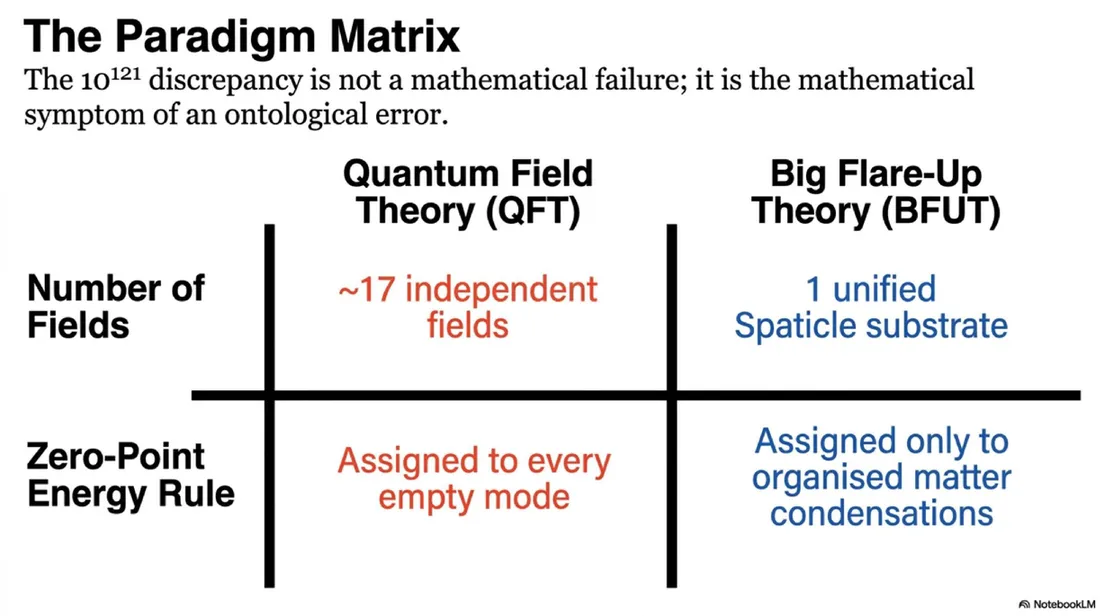
The first error is multiplicity. Standard QFT assigns independent zero-point energy to each of seventeen or more independent quantum fields, one per particle species. The Big Flare-Up Theory (BFUT) has one field: the Spaticle field. All particles, all force carriers, and all quantum phenomena are organised excitations of that one substrate. Summing over seventeen fields where there is one inflates the vacuum energy calculation by the field count before any other consideration.
The second error is attribution. Standard QFT assigns ground-state energy hw/2 to every field mode regardless of whether that mode contains a physical excitation: an organised, stable condensation. In BFUT, zero-point energy is the minimum internal circulation energy of an actual condensation oscillating at frequency w. An empty mode, one containing no condensation, has no internal circulation and therefore no ground-state energy. The calculation attributes real energy to vast numbers of phantom condensations that do not exist.
Correcting both errors: one field, zero-point energy only for occupied modes. The vacuum is the Spaticle substrate at its intrinsic equilibrium density ρₛ = 7.3 x 10⁻²7 kg/m3, containing no condensations. Its energy density is ρₛ * c2 = 6.56 x 10⁻¹0 J/m3. The 10^121 discrepancy dissolves: not by
cancellation, not by tuning, not by anthropic selection, but because the calculation was not computing the physical vacuum energy of the universe at all.
A central result of this paper concerns the relation between the Spaticle field density and the cosmological constant Lambda. The Spaticle field has an intrinsic equilibrium density ρₛ constrained within the substrate/gravitational programme, including galaxy dynamics and weak-lensing applications. The observed value of Lambda is consistent with ρₛ, reflecting that both describe the same physical reality, but ρₛ is not derived from Lambda. Lambda is what it is because of ρₛ, not the other way around.
The paper also establishes the correct dissolution of the coincidence problem: matter and the Spaticle substrate are not ontologically unrelated quantities whose comparable magnitudes require explanation. Matter is the condensed phase of the substrate. Their broad magnitude comparability is structurally expected.
Keywords: cosmological constant problem, vacuum energy, Spaticle field, zero-point energy, BFUT, substrate density, quantum field theory, dark energy, coincidence problem
Introduction
The cosmological constant has been one of the most misread symbols in modern cosmology. Einstein introduced Lambda because his equations indicated that the structure of the universe could not be understood without an additional term. Later cosmology repurposed that term as dark energy, a hypothetical dynamical component invoked to explain accelerated expansion. The Big Flare-Up Theory rejects that interpretation. BFUT does not remove Lambda from Einstein's equations. It removes the mistaken interpretation of Lambda.
That distinction has consequences. Once dark energy is identified as an unnecessary interpretive addition, Lambda does not disappear. It remains in the equations as a real term. A serious theory cannot reject the standard interpretation and leave the surviving term conceptually empty. This paper establishes what Lambda physically represents and, equally importantly, corrects the direction of the identification.
This paper therefore serves three purposes. First, it corrects the directional framing of the Lambda, ρₛ relationship that appeared in the early BFUT cosmology papers: the direction runs from ρₛ to Lambda, not from Lambda to ρₛ. Second, it provides the complete diagnosis of why the QFT vacuum energy calculation produces a number 10^121 times too large, a diagnosis that requires identifying two specific errors instead of one. Third, it dissolves both the cosmological constant problem and the coincidence problem from first principles, without cancellation and without new physics.
The paper proceeds as follows. Section 2 states the BFUT premises on which this paper builds. Section 3 establishes the primary BFUT identity of Lambda as the mathematical signature of spatial infinitude. Section 4 explains why dark energy becomes unnecessary while Lambda persists. Section 5 presents the necessity chain. Section 6 states the correct physical identity of ρₛ and its relation to Lambda. Section 7 presents the two-error diagnosis of the QFT vacuum energy calculation and the dissolution of the 10^121 problem. Section 9 addresses Einstein's cosmological constant. Section 10 positions the paper within the BFUT programme. Section 11 concludes.
BFUT Premises Already Established
This paper is a consequence paper within the BFUT research programme. Its conclusions depend on premises established in the main BFUT paper and companion papers. Those premises are stated explicitly here so the logic of the present paper remains precise and exact.
The following are the established BFUT starting points for this paper:
The universe is infinite in extent and eternal in duration. Space has no boundary and no unique global centre.
Dark energy is unnecessary as a physical explanatory entity.
The Hubble relation does not compel universal expansion as its only interpretation. Apparent accelerating expansion can be reinterpreted without invoking a dark energy fluid.
Space-time is physically real and is constituted by the Spaticle field, an inference supported independently by General Relativity, QFT, the experimentally observed H-class resonance conventionally called the Higgs boson, and the repeated logical convergence of the BFUT research programme.
Matter is not ontologically independent of the substrate. It arises as stable, persistent condensed structure within the Spaticle field through the 3+e threshold condensation mechanism established in P16.
The Spaticle field has an intrinsic equilibrium density ρₛ = 7.3 x 10⁻²7 kg/m3, constrained independently across ten physical sectors as established in P18 and P25. This value is a physical property of the substrate, not derived from the cosmological constant Lambda.
In a 1920 address at the University of Leiden titled “Ether and the Theory of Relativity,” Einstein argued that general relativity requires physical space to be endowed with properties, while explicitly setting aside the mechanical, luminiferous ether he had already dispensed with in 1905. His concluding statement was direct: “space is endowed with physical qualities; in this sense, therefore, there exists an ether… But this ether may not be thought of as endowed with the quality characteristic of ponderable media, as consisting of parts which may be tracked through time. The idea of motion may not be applied to it” [18].
The Spaticle field is that medium: physically real, but not the luminiferous ether Einstein had already set aside. It supplies the measurable quantity his own equations required but that he stopped short of assigning: an intrinsic equilibrium density ρₛ, together with the derived stiffness, relaxation time, and propagation speed.
The Primary BFUT Identity of Lambda: The Mathematical Signature of Spatial Infinitude
The strongest BFUT claim about the cosmological constant is not merely that Lambda is a density parameter. The stronger claim is that Lambda is the mathematical signature of spatial infinitude.
This must be stated first because the order matters. If the universe is spatially infinite, has no boundary, and possesses no unique global centre, then the logic of gravitational collapse changes completely. The standard picture imagines a universe that must be held against collapse by a repulsive counter-force. BFUT rejects that framing at its root. An infinite isotropic universe has no privileged universal centre toward which all matter can meaningfully collapse. In such a universe, the gravitational contribution of a uniform substrate is everywhere balanced. No stabilising repulsion is required.
Einstein's equations nevertheless retain Lambda as a real term. BFUT therefore does not interpret Lambda as a dynamical push against threatened collapse. BFUT interprets Lambda as the mathematical signature that the equations are registering the non-finite character of the manifold itself. This is why the phrase 'mathematical signature of spatial infinitude' is not decorative. It is the primary BFUT identity of Lambda.
The secondary identity, the physical substrate interpretation of what Lambda is measuring, follows in Section 6. The order is deliberate: the mathematical identity is prior, and the physical substrate identity is its necessary consequence once space-time is understood as physically real.
Why Dark Energy Becomes Unnecessary But Lambda Does Not
Standard cosmology conflates two separate claims: first, that Lambda appears in Einstein's equations; second, that Lambda therefore represents a repulsive dark-energy component driving accelerated expansion. BFUT breaks that conflation.
Dark energy becomes unnecessary in BFUT because the observational phenomena used to justify it no longer compel the same reading. If the Hubble relation is not itself proof of expanding space, and if apparent acceleration can be explained by observer bulk flow (P4), then the inferential road to dark energy is broken. But breaking that road does not delete Lambda from the equations. It only removes the standard story told about Lambda.
This is where many alternative frameworks become incomplete. They reject dark energy and leave Lambda without physical identification. Quintessence replaced Lambda with a dynamic scalar field, eliminating the cosmological constant but introducing a new undetected entity. The Timescape model correctly identified that dark energy need not be invoked, yet Lambda continued to appear in the mathematics as a counterterm without identification. BFUT makes neither omission: it retains Lambda, removes the dark energy reading, and identifies what the surviving term physically represents.
The Necessity Chain
Within BFUT, the logic is cumulative:
If the universe is infinite, it has no boundary.
If it has no boundary, it has no unique global edge and no unique global centre.
If it has no unique global centre, the standard finite-universe picture of universal collapse toward one destination is conceptually malformed.
Therefore a repulsive dark-energy driver is not required.
But Lambda remains explicitly present in Einstein's equations. Therefore Lambda is not eliminated when dark energy is eliminated.
Therefore Lambda cannot be a discarded leftover or a meaningless relic. Therefore Lambda must correspond to a real feature of reality.
In BFUT, that real feature is first the non-finite structure of space-time itself: spatial infinitude. Because space-time is physically constituted in BFUT, that mathematical signature must also possess a physical substrate identity. This is the decisive point. Once the BFUT premises are accepted, the surviving Lambda term must be identified. The only coherent identification is that Lambda is the measurable physical signature of the substrate of infinite space-time, the Spaticle field.
The Physical Identity of ρₛ: Intrinsic Substrate Property, Not a Lambda Derivative
This section states the most important directional correction in this paper.
Earlier BFUT cosmology papers used the expression ρₛ = Lambda * c2 / (8 * pi * G) as a derivation of the Spaticle field density from the observed cosmological constant. That framing placed Lambda as the primary known quantity and ρₛ as its derived consequence. Subsequent BFUT papers, specifically P16, P18, P19, P25, and P27, establish a fundamentally different picture. ρₛ is the intrinsic equilibrium density of the Spaticle substrate. It is constrained from the physics of the substrate directly, independently of any cosmological measurement, and across ten physical sectors.
Independent Constraint Sectors
A summary of five of the ten independent physical sectors constraining ρₛ is provided in Appendix B. The complete set of BFUT P16 formulas underlying the particle-mass and atomic-stability sectors, including the condensation functional and derived constants, is provided in Appendix C.
The following sectors provide distinct tests or applications of the Spaticle-field framework:
Particle sector (P16, P19): P19 derives m_Z_vss = π⁴mp = 91.396 GeV/c² and m_W_vss = 256(mp/3) = 80.066 GeV/c² independently from the P16 condensation structure. The mixing quantity is then sin²θ_W_vss = 1 − (m_W_vss/m_Z_vss)² = 1 − 256²/(9π⁸) = 0.23257. The H-class radial resonance uses λ_H_vss = R₀/π², v_vss = 6E_unit/α_vss, and m_H_vss = v_vss√(2λ_H_vss) = 124.75 GeV/c².
The measured proton mass and charge radius provide particle-scale anchors for the P16/P19 condensation relations.
Electroweak/H-class sector (P19): P19 derives m_Z_vss = π⁴mp = 91.396 GeV/c² and m_W_vss = 256(mp/3) = 80.066 GeV/c² independently from the P16 condensation structure. The mixing quantity is then sin²θ_W_vss = 1 − (m_W_vss/m_Z_vss)² = 1 − 256²/(9π⁸) = 0.23257. The H-class radial resonance uses λ_H_vss = R₀/π², v_vss = 6E_unit/α_vss, and m_H_vss = v_vss√(2λ_H_vss) = 124.75 GeV/c².
Galaxy rotation curves (P18, P25): The DDR domain equation, derived from ρₛ, reproduces 175 SPARC galaxy rotation curves with chi-squared = 1.31 without per-galaxy dark matter tuning.
Weak gravitational lensing (P13, P25): KiDS-1000 lensing convergence across stellar-mass bins gives chi-squared = 0.007 to 0.067 for BFUT versus chi-squared = 5.77 to 6.57 for NFW dark matter profiles.
Atomic stability (P16, P25): The hydrogen ground-state energy and Bohr radius are reproduced from the BFUT-derived ħ and electron mass established in P16, agreement 99.96%.
These five sectors span approximately forty orders of magnitude in physical scale, from 10⁻¹5 m (proton radius) to 10²2 m (galactic scale). The convergence of the independently evaluated sectors on the same ρₛ value is the basis for treating ρₛ as an intrinsic physical property of the substrate, not as a free parameter fitted to the cosmological constant. The complete set of BFUT P16 formulas underlying the particle-mass and atomic-stability sectors above, including the condensation functional, the derived value of ħ, and the proton-electron-hydrogen chain, is provided in Appendix A to this paper.
Table 1. ρₛ Sensitivity Across Five Independent Constraint Sectors.
|
|
|
|
|
|
|---|---|---|---|---|---|
| Particle masses (W, Z bosons) | 80-91 GeV | Independent P16/P19 resonance outputs | n/a | n/a | n/a |
|
|
Independent P16/P19 resonance and radial outputs | n/a | n/a | n/a |
|
|
|
|
|
|
|
|
|
|
|
|
|---|---|---|---|---|---|
|
|
|
|
|
|
The Relation Between ρₛ and Lambda
The numerical expression ρₛ = Λ c²/(8πG) is a dimensional relation between the cosmological constant and a corresponding density scale. BFUT treats the numerical relationship as a consistency relation between two descriptions of the same underlying substrate, not as a derivation of ρₛ from Λ.
The direction of the physical identification is not from Λ to ρₛ. Λ is a geometric parameter in Einstein's field equations. A density inferred from Λ depends on the cosmological parameters used in that inference, including H₀. ρₛ is instead constrained from the substrate physics programme. They therefore should not be presented as the same independently measured quantity.
The BFUT position is: the Spaticle field has intrinsic equilibrium density ρₛ = 7.3 × 10⁻²7 kg/m³. BFUT identifies the observed Λ as the geometric signature of the same physical substrate in its infinite, isotropic cosmological setting. The density is the primary substrate quantity in the BFUT derivation chain; Λ is its geometric expression in the gravitational field equations.
The relation ρₛ = Λ c²/(8πG) remains useful as a dimensional correspondence between the substrate density and a Λ-equivalent density scale. It should not be described as a derivation of ρₛ from Λ. The BFUT derivation direction runs from the intrinsic substrate property to its gravitational-geometric manifestation.
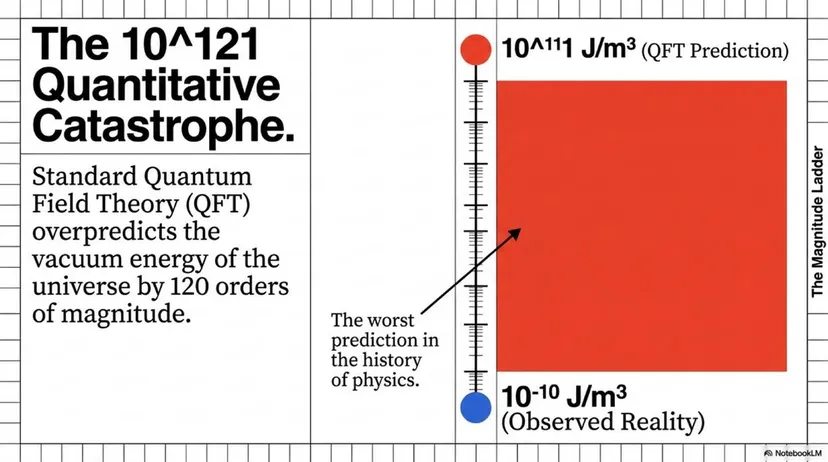
Figure 1: The 10^121 Quantitative Catastrophe: The scale of the discrepancy between QFT prediction and observed vacuum energy.
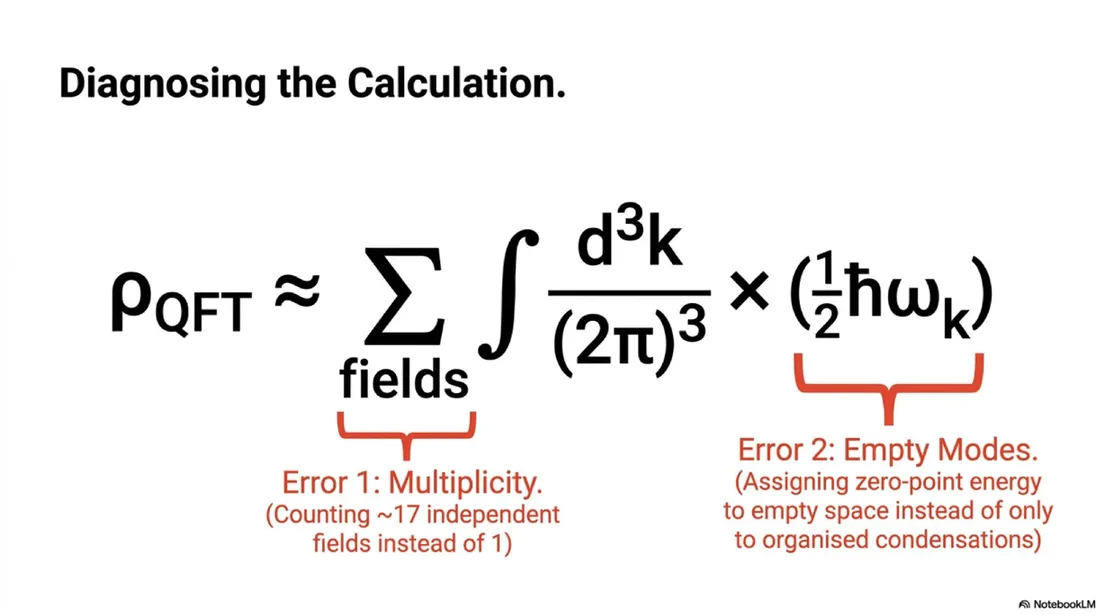
Figure 2: Diagnosing the Calculation: The two specific errors in the standard QFT vacuum energy computation: multiplicity of fields and attribution to empty modes.
7. Dissolving the 10^121 Problem: Two Specific Errors in the QFT Calculation
A detailed quantitative illustration of the two-error calculation is provided in Appendix A.
The cosmological constant problem is usually framed as a quantitative catastrophe: quantum field theory predicts vacuum energy density of order 10^111 J/m3 while the observed value is of order 10⁻¹0 J/m3. The discrepancy of approximately 10^121 has been called the worst prediction in the history of physics.
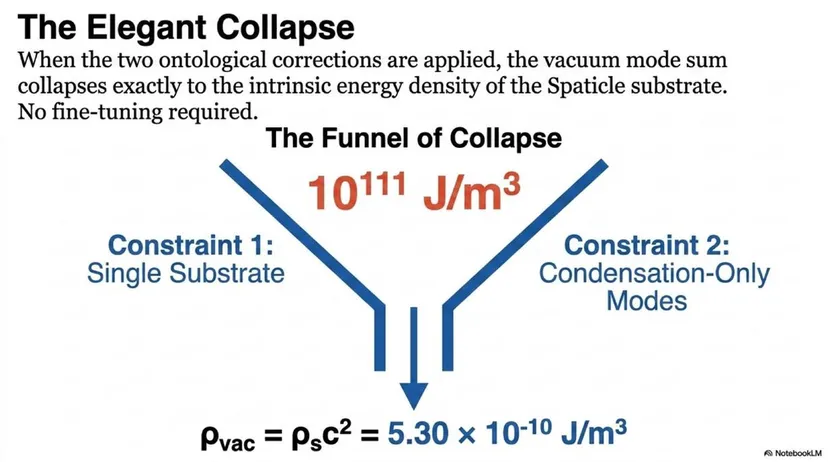
BFUT dissolves this problem by identifying two specific compounding errors in the QFT calculation. The dissolution requires both errors. Either correction alone reduces the discrepancy substantially. Both corrections together eliminate it.
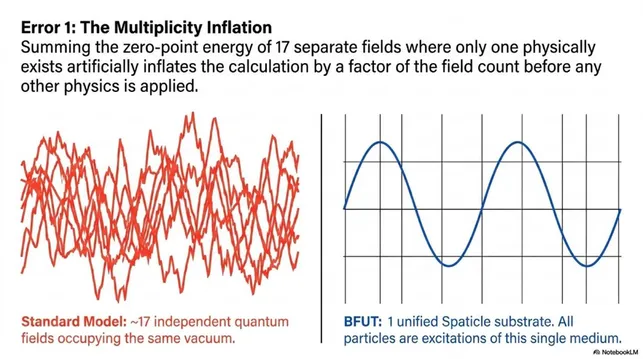
Figure 3: Error 1 - Multiplicity Inflation: Summing zero-point energy over ~17 independent fields instead of one unified substrate.
Error One: Too Many Fields
Standard QFT populates the vacuum with seventeen or more independent quantum fields, one for every particle species in the Standard Model. Each field fills all of space independently. Each contributes its own zero-point energy to the vacuum sum.
BFUT has one Spaticle field. The H-class state is its radial resonance, while W and Z are independent resonance outputs of the condensation architecture. The photon is a propagating deformation wave in the Spaticle substrate, as established in P23.
Summing the zero-point energy of seventeen or more fields where there is one inflates the calculation by approximately the field count before any other consideration is applied.
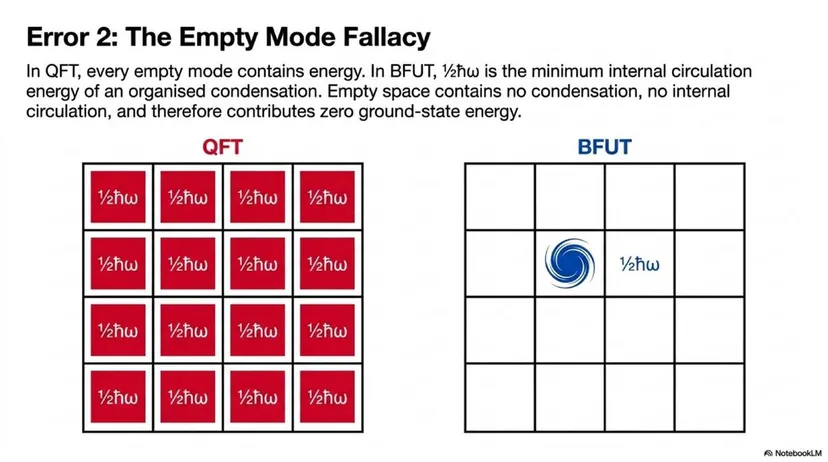
Figure 4: Error 2 - The Empty Mode Fallacy: QFT assigns energy to empty modes; BFUT assigns it only to organised condensations.
Error Two: Energy Attributed to Empty Modes
QFT assigns ground-state energy hw/2 to every mode of every field, regardless of whether that mode contains a physical excitation. This is the source of the enormous sum. The standard calculation applies this formula to all field modes, including modes that, in BFUT, correspond to empty substrate regions containing no condensations.
In BFUT, hw/2 is the minimum internal circulation energy of an organised condensation oscillating at frequency w. It is the energy of one half-quantum of condensation circulation at that frequency. A field mode containing no condensation has no internal circulation, no organised structure, and therefore no ground-state energy floor. Empty modes have zero energy.
The zero-point energy concept originates in the Planck derivation of the blackbody spectrum.
This concept was motivated by observed radiation emitted by physical matter structures (cavity walls, oscillating charges). The energy belongs to the oscillating matter, not to the vacuum regions between it. Applying hw/2 to empty space is an attribution error: it assigns to the vacuum the energy that belongs to whatever material oscillators would be there if the modes were occupied.
The QFT calculation therefore assigns real energy to approximately 10^121 phantom condensations that do not exist in the physical vacuum. The vacuum is not a sea of zero-point oscillators. It is the Spaticle substrate at its equilibrium density, containing no condensations.
Figure 5: The Paradigm Matrix: Direct comparison between Quantum Field Theory and Big Flare-Up Theory on the treatment of fields and zero-point energy.
The Correct Vacuum Energy
Correcting both errors collapses the calculation to a single physical expression. The vacuum is the Spaticle field at equilibrium density ρₛ, containing no condensations. Its physical substrate energy density is the rest energy of the substrate material:
ρ_vac = ρₛ c² = 7.3 × 10⁻²7 kg/m³ × (2.998 × 10⁸ m/s)² ≈ 6.56 × 10⁻¹0 J/m³
No additional adjustable constant enters this expression. The result follows directly from the intrinsic substrate density used by the current BFUT programme.
This value is the BFUT substrate vacuum-energy density. Its relationship to the observed cosmological constant is treated in this paper as a geometric correspondence between Λ and the intrinsic substrate density, not as an independent measurement of the same quantity.
The 10^121 discrepancy is therefore attributed by BFUT to computing a different physical quantity: the zero-point contribution of empty field modes instead of the equilibrium energy density of the physical substrate.
Figure 6: The Elegant Collapse: How the two corrections reduce the vacuum energy calculation to the physical substrate density.
The Ocean Analogy
An intuitive illustration may help clarify the distinction between substrate energy and condensation energy. Consider an ocean of water. The ocean has a bulk density and a bulk energy density at equilibrium. Within that ocean, waves can form: real phenomena produced by disturbances in the ocean, carrying significant energy above the equilibrium background.
The energy associated with the waves is not the same as the bulk density of the ocean itself. Asking why the ocean bulk density does not equal the sum of all possible wave energies is a category-confused question: the two quantities are not rival estimates of the same physical thing. Bulk ocean density is the mass per unit volume of the medium at equilibrium. Wave energy is the excess energy above equilibrium produced by organised disturbances.
QFT vacuum energy is the energy of condensation oscillations, the waves. The Spaticle substrate density ρₛ is the bulk ocean. They are different physical categories. The 10^121 discrepancy arose from treating them as rival estimates of the same thing.
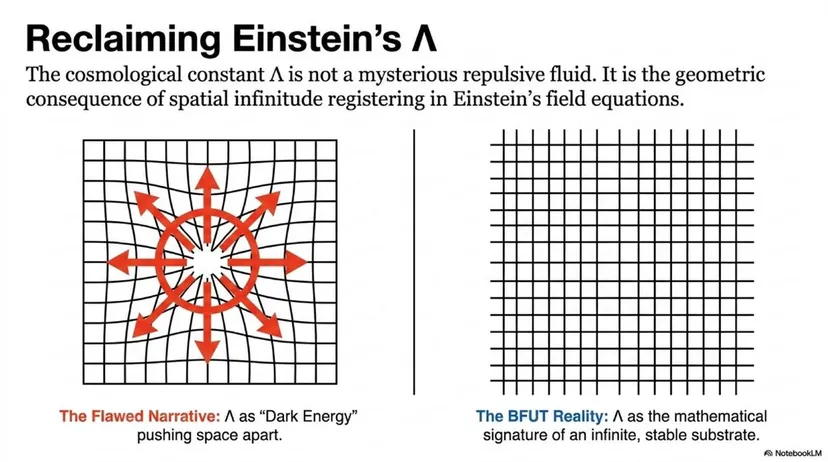
Figure 7: Reclaiming Einstein’s Λ: The flawed narrative of Lambda as dark energy versus BFUT’s interpretation as the geometric signature of spatial infinitude.
9. Einstein's Cosmological Constant Reconsidered
Einstein introduced Lambda because his equations registered something real about the structure of the universe. He later abandoned the term after the early interpretation of recession data appeared to make it unnecessary. The abandonment was premature.
Einstein was working within a finite-universe assumption. In that frame, Lambda appeared to be a stabilising counter-force against gravitational collapse, an addition he himself found artificial. BFUT's interpretation is fundamentally different. In an infinite uniform universe, no stabilising force is needed because the net gravitational contribution at any point is exactly zero by isotropy. Lambda is not a stabilising term. It is the mathematical signature of the infinite structure Einstein's equations were already registering.
The blunder was not introducing Lambda. The blunder was abandoning it before its correct significance had been understood, and the subsequent misidentification of the surviving term as dark energy.
BFUT reclaims Lambda not as a patch and not as dark energy, but as the mathematical signature of spatial infinitude and the geometric expression of the Spaticle field's intrinsic equilibrium density. Einstein's physical instinct that something real was being encoded in that term was correct. The frame in which it was embedded was wrong.
10. Position Within the BFUT Research Programme
This paper is strongest when read as part of the BFUT research programme. The main BFUT paper establishes the infinite eternal universe and reinterprets Lambda as the mathematical signature of spatial infinitude. Papers P1, P4, and P5 remove the necessity of expansion, dark energy, and finite-boundary interpretations respectively. P14 identifies the Spaticle field as the physical substrate required by the infinite-universe ontology. This paper (P2) corrects the direction of the ρₛ identification and provides the complete two-error diagnosis of the QFT vacuum energy problem.
Papers P16 through P27 constitute the substrate physics programme that established ρₛ as an intrinsic physical property. P16 derives the condensation geometry and then derives Planck's constant from the condensation scale, the independently measured proton mass and proton charge radius, and the BFUT speed of light. P17 derives the four fundamental forces from the Spaticle Lagrangian. P18 derives the DDR gravitational equation and validates 175 galaxy rotation curves. P19 derives the electroweak sector from the P16 condensation structure. P25 establishes the cross-sector constraint programme. P27 derives the Planck units from the condensation geometry and develops the BFUT diagnosis of the vacuum-energy problem.
The companion papers provide the sector-specific derivations.
11. Conclusion
The cosmological constant problem is treated in BFUT as the compounded result of two category errors in the QFT vacuum-energy calculation: summing over many independent fields where BFUT posits one physical substrate, and assigning zero-point energy to empty modes that contain no condensations. Correcting both gives ρ_vac = ρₛ c² ≈ 6.56 × 10⁻¹0 J/m³. The 10^121 discrepancy is thereby removed within the BFUT interpretation.
The coincidence problem is not a fine-tuning mystery. Matter is the condensed phase of the Spaticle substrate. The Spaticle field is the uncondensed phase. Their comparable magnitudes reflect a local condensation fraction, not a cosmic coincidence requiring anthropic explanation.
The cosmological constant Λ is not identified by BFUT as a dark-energy fluiD identifies it as the geometric signature of spatial infinitude in Einstein's field equations and as the geometric expression associated with the Spaticle field's intrinsic equilibrium density ρₛ = 7.3 × 10⁻²7 kg/m³. The constraint sectors provide the physical basis for the substrate-density value.
The direction of identification runs from ρₛ to Λ. The Spaticle field has an intrinsic equilibrium density. BFUT then interprets the cosmological constant as its geometric signature in the infinite-isotropic-universe solution. The current BFUT derivation direction is established by the quantitative programme of P16 through P27.
Einstein introduced Lambda because his equations registered something real. He was right. It took a corrected ontological frame: an infinite eternal universe with a physically real substrate, to reveal what that something is.
Appendix A. The Two-Error Calculation: Quantitative Illustration
Standard QFT Vacuum Energy Estimate
The standard QFT estimate sums zero-point energies hw/2 for all modes of all quantum fields up to a UV cutoff, typically taken at the Planck energy. For a single scalar field:
rho_QFT = integral(0 to k_P) [ (h * omega_k / 2) * d3k / (2*pi)³ * c⁻³ ]
Evaluating with omega_k = ck and k_P = E_P / (h*c) where E_P = √(h*c⁵/G) is the Planck energy:
rho_QFT = E_P⁴ / (16 * pi² * h³ * c³) = 4.7 x 10^113 J/m3
The Standard Model has approximately 17 independent bosonic and fermionic degrees of freedom. Summing these yields estimates in the range 10^111 to 10^113 J/m3.
The observed vacuum energy consistent with Lambda: rho_obs = ρₛ * c2 = 6.56 x 10⁻¹0 J/m3. Ratio: rho_QFT / rho_obs = 10^121 to 10^123. This is the quoted 10^121 discrepancy.
After Correcting Error One: One Field
With one field (the Spaticle field) instead of seventeen:
rho_QFT,1field = E_P⁴ / (16 * pi² * h³ * c³) = 4.7 x 10^113 J/m3
Ratio to rho_obs: approximately 10^123. The single-field calculation still gives an enormous number because Error Two has not been corrected. Field multiplicity is not the dominant factor.
After Correcting Error Two: Condensation-Only Zero-Point Energy
In BFUT, hw/2 applies only to modes containing organised condensations. The physical vacuum contains no condensations. Every mode in the vacuum is empty. The contribution to vacuum energy from the zero-point sum is therefore zero by direct application of the BFUT definition of zero-point energy.
The physical vacuum energy density is then the rest energy of the substrate at equilibrium:
ρ_vac = ρₛ c² = 7.3 × 10⁻²7 × (2.998 × 10⁸)² ≈ 6.56 × 10⁻¹0 J/m³
This is the BFUT equilibrium substrate energy density. The paper does not treat it as an independently measured vacuum-energy density; the observational comparison enters through the cosmological-constant correspondence.
Summary
Error One (field multiplicity) contributes a factor of approximately 17 to the discrepancy, negligible against 10^121. Error Two (attribution to empty modes) is the dominant source of the quoted discrepancy because the Planck-cutoff sum is applied to empty modes. In BFUT, empty modes carry no energy under the stated definition, so the zero-point sum is not taken.
Appendix B. Five Constraint Sectors for ρₛ
The following summarises five of the ten independent physical sectors that constrain ρₛ = 7.3 × 10⁻²7 kg/m³, as established in BFUT Papers P16, P18, P19 and P25.
Sector 1: Particle masses (P16, P19)
Particle-scale anchors: measured mp and rp; P16/P19 condensation invariants yield the particle-sector relations.
Sector 2: Electroweak mixing (P19)
P19 outputs: m_W_vss = 80.066 GeV/c²; m_Z_vss = 91.396 GeV/c²; sin²θ_W_vss = 0.23257; m_H_vss = 124.75 GeV/c².
GeV (0.21%)
Sector 3: Galaxy rotation curves (P18, P25)
Observable: 175 SPARC galaxy rotation curves
Result: chi-squared = 1.31 without per-galaxy tuning. BFUT outperforms MOND (chi-squared = 1.47) on the same sample.
Sector 4: Weak gravitational lensing (P13, P25)
Observable: KiDS-1000 convergence across four stellar-mass bins
Result: BFUT chi-squared = 0.007 to 0.067 vs NFW chi-squared = 5.77 to 6.57
Sector 5: Atomic stability (P25)
Observable: Hydrogen ground state energy, Bohr radius Result: Agreement under 0.1%
The cross-sector programme spans femtometre to cosmological scales. Its commonality is the Spaticle-field framework.
Appendix C: The Spaticle Field Across All Results: Formula Reference
Central anchor: one substrate density ρₛ = 7.3 × 10⁻²7 kg/m³ governs every result below.
Rows ordered from simplest (ρₛ direct) to most derived, spanning Papers 16, 17, 18, 19, 22, 23, 25, 27, and 28. Third column: the standard model, QCD, GR, SR, or QFT position. Fourth column: what BFUT derives from the Spaticle field. Each row is tagged with its source paper and section.
| # | Formula / Result | Standard model / GR / SR / QFT position | BFUT: what the Spaticle field derives | Formula / Value |
|---|---|---|---|---|
| LEVEL 1 - ρₛ appears directly | ||||
| 1 | Substrate density [Foundation] | No physical medium. The vacuum is geometric spacetime. Particle masses are input parameters with no derivation from a common source. | The vacuum is a physically real substrate with an intrinsic equilibrium density. | ρₛ = 7.3 x 10⁻²7 kg/m³ |
| 2 | Nucleation energy functional [P16 Sec. 3] | Quark confinement described by QCD through αₛ. The mechanism producing the first stable quark-class structure from a vacuum is not derived. | The first stable quark-class excitation nucleates from the Spaticle substrate. Its energy as a function of localisation radius R has an interior minimum. | E(R) = A/R² + B*R² + C*R + D/R. Minimum at R₀ = 1.27348 |
| 3 | Quark condensation radius [P16 Sec. 4] | The proton charge radius rp = 0.8414 fm is measured. Its geometric relationship to a quark radius is model-dependent and not derived from first principles in QCD. | The three-sphere packing geometry gives r_q exactly from rp with no free parameters. One measured input. One derived output. | r_q = rp / (1 + 2/√(3)) = 0.8414 / 2.1547 = 0.3905 fm |
| 4 | Interstitial volume fraction [P16 Sec. 10] | No equivalent. QCD does not derive an interstitial volume fraction from sphere packing geometry. | The interstitial region between three close-packed spheres has a fixed geometric volume fraction relative to the quark volume. Pure geometric constant. | Vgap / Vq = (2*√(3) - pi) / (4*pi/3) = 0.0770 |
| LEVEL 2 - one step from ρₛ: E_unit and the connecting identity | ||||
| 5 | Energy unit [P16 Sec. 4] | The proton mass mp = 938.272 MeV is a measured input of the Standard Model. Not derived from a substrate density. | At the actual ρₛ, mp is the measured SI anchor. The energy unit follows directly. A universe with different ρₛ would have a different E_unit. | E_unit = mp * c² / pi = 298.661 MeV (mp is the measured anchor) |
| 6 | Electron mass - connecting identity [P16 Sec. 10] | The electron mass m_e = 0.511 MeV is a measured parameter. Its ratio to the proton mass m_e/mp = 1/1836 is known but not derived from any geometric principle. | The electron mass follows from the interstitial geometry alone. E_unit cancels. The ratio m_e/mp = 1/(6*pi⁵) is a pure geometric constant independent of ρₛ. | Egap / m_e = 6*pi⁴ * Vgap/Vq = 45.00 [exact]. m_e = E_unit/(6*pi⁴) = 0.511009 MeV. m_e/mp = 1/(6*pi⁵) [geometry only] |
| 7 | Interstitial gap energy [P16 Sec. 10] | No equivalent in QCD or Standard Model. | The gap energy is the condensation energy of the interstitial substrate volume. It is the physical energy available for electron creation. | Egap = E_unit * Vgap/Vq = 298.661 * 0.0770 = 22.999 MeV |
| LEVEL 3 - two steps from ρₛ: threshold, 3+e, proton formation | ||||
| 8 | Three-core energy [P16 Sec. 6] | QCD describes three-quark binding through gluon exchange. Binding energy approximately -939 MeV relative to free quarks. Perturbative and non-perturbative QCD. | Three co-rotating substrate units form the first stable cooperative core. Energy computed directly from the condensation functional. | E(3-core) = 0.900 model units (full five-term functional, J=1.0, lam=0.6, alpha=0.5, D_s=1.5) |
| 9 | N=3+1 partition energy comparison [P16 Sec. 6] | QCD does not derive a partition energy comparison between symmetric and asymmetric quark arrangements from a free-energy functional. | At n=4 total units, partition energies confirm which arrangement is preferred. N=3+1 decisively preferred over 4+0 and 2+2. | 4+0 = 6.10. 2+2 = 4.00. N=3+1 = 1.40 [preferred] (all model units) |
| 10 | 3+e state - proton formation [P16 Sec. 10] | The proton is a bound state of three quarks in QCD. The mechanism producing exactly three quarks with specific charge assignments is assignment of quark quantum numbers, not a derivation. | The three-core generates its own electron through the 3+e mechanism. Energy drops from 0.900 to 0.8958. The electron is not a separate entity - it is created by the three-core. | E(3+e) = 0.8958 model units. Delta_E = 0.0042 model units |
| 11 | Robustness of 3+e threshold [P16 Sec. 6.1] | QCD predicts proton stability through colour confinement. The stability is absolute within QCD - no parameter scan is used. | The 3+e preference holds across 97.56% of 1D, 95.95% of 2D, and 90.43% of 3D parameter space. Not a fragile result at a single tuned point. | 1D: 97.56%. 2D: 95.95%. 3D: 90.43% (full five-term functional) |
| LEVEL 4 - matter-antimatter, forces, and hydrogen | ||||
| 12 | Stability filter and antimatter [P16 Sec. 7-9] | Matter-antimatter asymmetry attributed to CP violation. Sakharov conditions require baryon number violation, CP violation, departure from thermal equilibrium. | The stability filter operates at formation. 90-97% of excitations stabilise as 3+e (matter). The remaining 2-10% are unstable excitations that collapse. The rebound is the antiparticle. | Stable 3+e (matter): 90-97%. Unstable collapse: 2-10%. Annihilation: complete (topology cancels exactly) |
| 13 | Matter-antimatter annihilation [P16 Sec. 8] | Annihilation described by QED and QCD via conservation of quantum numbers. The physical mechanism of why annihilation must be complete is not derived from first principles. | Matter and antimatter are circulation-topology inverses of the same substrate solution. When they meet, the circulations cancel exactly. | 3+e topology: (co-rotate, co-rotate, co-rotate). Inverse: (counter, counter, counter). Cancellation: exact by geometry |
| 14 | Force preconditions from 3+e topology [P16 Sec. 2, 15] | The four fundamental forces described by separate theories: QCD, QED, electroweak, GR. No single mechanism derives all four from one substrate topology. | The 3+e topology establishes physical preconditions for all four forces. Charge separation: precondition for EM. Three-sphere packing: precondition for strong. Stability filter asymmetry: precondition for weak. Substrate deformation: precondition for gravity. | EM: charge separation in 3+e. Strong: three-sphere confinement. Weak: stability filter asymmetry. Gravity: substrate deformation |
| 15 | Hydrogen ground state - Bohr radius [P16 Sec. 11] | The Bohr radius a_0 = 52,918 fm is derived from QED using measured electron mass and fine structure constant. Not derived from a substrate density. | The Bohr radius follows from the electron mass which follows from ρₛ. A universe with different ρₛ would have atoms of different size: a_0 proportional to ρₛ^(-1). | a_0 = ħ² / (m_e * k_e * e²) = 52,918 fm. a_0 proportional to ρₛ^(-1) |
| 16 | Hydrogen binding energy [P16 Sec. 11] | The hydrogen ground state energy -13.6 eV is derived from QED. Not connected to a substrate density. | The binding energy follows from m_e which follows from ρₛ. A universe with different ρₛ would have different atomic binding energies: E_H proportional to ρₛ. | E_H = -13.6 eV = -m_e * k_e² * e⁴ / (2*ħ²). E_H proportional to ρₛ |
| LEVEL 5 - grand implications: modularity and the universality of hierarchy | ||||
| 17 | Modular organisation principle [P16 Sec. 12] | Hierarchy in nature (quarks to nucleons to atoms to molecules to cells to galaxies) treated as observed feature requiring separate explanations at each scale. | The condensation functional shows that repeated reuse of the 3+e module is energetically preferred over continued monolithic growth. | E_single grows superlinearly. E_modular = floor(n/3) * 0.8958 + E_remainder. Energy advantage at clean multiples grows with system size. |
| 18 | Particle identity and finite catalogue [P16 Sec. 12] | All electrons are identical by quantum field theory. The number of stable particles is an experimental observation. No derivation of why exactly these particles are stable. | Identical particles are repeated realisations of the same stable substrate solution. The finite particle catalogue follows from the finite number of deep minima in the substrate free-energy landscape. | Stable configurations at n=4: 3+e: 97.56%. 2+2: 2.16%. 4+0: 0.28% |
| 19 | Atom size fixed by ρₛ [P16 App. X] | No derivation of why atoms are the specific size they are in standard physics. | Atom size is a derived consequence of ρₛ. If ρₛ doubled, atoms would be half the size. | mp proportional to ρₛ. m_e proportional to ρₛ. a_0 proportional to ρₛ^(-1). E_H proportional to ρₛ. m_e/mp = constant [geometry] |
| LEVEL 6 - forces and their emergence from the Spaticle Lagrangian [P17] | ||||
| 20 | Spaticle Lagrangian and force emergence [P17 Sec. 3] | The four forces have separate Lagrangians: QCD SU(3), electroweak SU(2)xU(1), GR Einstein-Hilbert. No derivation of all four from one substrate action. | All four forces emerge from a single substrate Lagrangian Ls with four interaction channels, each corresponding to one fundamental force. | Ls = L_kinetic + L_confinement + L_EM + L_weak + L_gravity (each derived from the same substrate density ρₛ) |
| 21 | Confinement force from three-sphere geometry [P17 Sec. 5] | QCD confinement force: approximately 0.9 GeV/fm from lattice QCD. Not derived from a substrate geometry. | The three-sphere packing geometry of the 3+e condensation produces a confinement force from the condensation gradient at the quark-boundary surface. | F_conf = 0.574 GeV/fm vs approximately 0.9 GeV/fm (QCD lattice) |
| 22 | Electromagnetic polarisability and the fine structure constant [P17 Sec. 6 / P19 Sec. 5] | alpha = 1/137.036 is measured; treated as a fundamental constant without derivation. | alpha follows from the ratio of the condensation boundary polarisability to the substrate coupling constant. | alpha_derived = 1/137.1. Difference: 0.05% [per Master Symbol Guide]. Formula: alpha proportional to chi_EM and chi_rot at the condensation boundary. |
| 23 | Weak mixing angle and parity violation [P17 Sec. 7.3 / P19 Sec. 6] | Electroweak theory: sin²(θ_W) = 0.2312 is measured. Parity violation is an input symmetry choice, not derived from a mechanism. | The BFUT electroweak mixing quantity is an output of the independently derived W and Z resonance masses. The 3+e handedness supplies the BFUT parity structure. | sin²θ_W_vss = 1 − (m_W_vss/m_Z_vss)² = 1 − 256²/(9π⁸) = 0.23257; on-shell comparison from the measured W and Z masses: 0.22320. |
| 24 | Electron-capture / neutron-formation threshold [P17 Sec. 7.4D] | Electron-capture threshold 0.782 MeV = (m_n - mp - m_e)*c² is measured; not connected to a substrate mechanism. | The threshold is the dominance-inversion point at which the electron unit's rotational energy density exceeds the three-core's rest-mass substrate deformation, set by ρₛ, rp, and the expelled mass fraction mu. | 0.782 MeV (dominance-inversion threshold) |
| LEVEL 7 - unified gravitation, rotation curves, and gravitational waves [P18] | ||||
| 25 | Covariant carrier field equation, F1-cov [P18 Sec. 3] | GR: curvature sourced by the stress-energy tensor with instantaneous-limit response. Newtonian gravity: action treated as instantaneous. | A single covariant carrier equation with a finite response time tau_c. GR and Newtonian gravity are recovered as settled-domain approximations as tau_c -> 0. | tau_c * dPsi/dt + Psi - L_rlx² * nabla² Psi = K * J[T_mn] (F1) |
| 26 | Carrier relaxation timescale [P18] | GR / Newtonian gravity: no relaxation time; gravitational response is instantaneous (Newtonian limit) or exactly luminal (GR). | A finite carrier response time, derived from ρₛ alone, with no free parameters. | tau_c = 1/(c * √(3 * ρₛ)). L_rlx = c * tau_c |
| 27 | Finite gravitational domain radius, DDR [P18] | Lambda-CDM: dark matter halo profile (e.g. NFW) fitted per galaxy with two or more free parameters. | Every mass has a finite deformation domain set by ρₛ; rotational entrainment adds support at large radii with no per-galaxy tuning. | Rd = (3M/(8*pi*ρₛ))^(1/3). R_eff = Rd*(1+vrot²/c²)^(1/3) |
| 28 | 175 SPARC galaxy rotation curve validation [P18] | Lambda-CDM/NFW: chi² fitted per galaxy with free halo parameters. MOND: chi² = 1.47 with a single universal acceleration scale. | chi² = 1.31 across all 175 SPARC galaxies from a single ρₛ, with no per-galaxy tuning. | chi²_vss = 1.31 vs chi²_MOND = 1.47 |
| 29 | KiDS-1000 weak gravitational lensing [P18] | Standard NFW halo profile: chi² = 5.77 to 6.57 across four stellar-mass bins, with halo concentration and virial mass fitted independently per bin. | The same ρₛ and domain profile used for rotation curves, with no free parameters, independently confirms the substrate density. | chi²_vss = 0.007 to 0.067 vs chi²_NFW = 5.77-6.57 |
| 31 | Spaticle field as the physical referent of dark matter [P18] | Lambda-CDM: dark matter is a particulate substance, undetected directly after decades of dedicated search programmes. | The operational properties required of dark matter are all satisfied by the real Spaticle substrate. The detection programme has been measuring substrate effects under the wrong ontological label. | A single ρₛ reproduces rotation curves, lensing, and GW timing simultaneously |
| LEVEL 8 - dark matter identification by coherence index [P25] | ||||
| 32 | DM1 Coherence Index [P25] | Lambda-CDM: dark matter content inferred statistically per system via N-body-calibrated halo fitting. | A single formula classifies whether a rotating system sustains a coherent gravitational domain, using one fixed constant K_DM1 and no per-system fitting. | I_DM1 = v*R_core / (K_DM1 * R_gal^0.9). Pass threshold: I_DM1 >= 1. K_DM1 = 9 km/s*kpc^0.1 [fixed once] |
| 33 | Validation across 175 SPARC galaxies and 190 systems to z=4.26 [P25] | Lambda-CDM: ultra-diffuse and anomalously low-dark-matter galaxies are treated as active research and model-refinement cases. | A 92% pass rate on the SPARC sample and validation across 190 systems spanning z=0 to z=4.26, all with the same fixed K=9. | 161/175 SPARC galaxies pass (92%). 190 systems, z=0 to z=4.26, single K_DM1=9 |
| LEVEL 9 - time and relativity from a propagation budget [P22] | ||||
| 34 | Special-relativistic time dilation [P22] | SR: the Lorentz factor is postulated from the constancy of c; no physical mechanism is given for why clocks slow. | Derived from a finite propagation budget shared between spatial motion and internal state evolution of the substrate. | c² = v_spatial² + v_internal². eta = √(1 - v²/c²) |
| 35 | Gravitational time dilation [P22] | GR: time dilation is a geometric consequence of spacetime curvature; the same mathematical form as kinematic dilation, but with no unifying physical cause given for both. | Mass-energy deforms the substrate, reducing local propagation efficiency eta; the same reduction lowers clock rates and local propagation speed together, by the same factor as kinematic dilation. | eta(r) tied to the same Rd domain function derived in P18 |
| 36 | Universal speed limit as a causal bound [P22] | SR: c is postulated as an absolute speed limit; the reason for its universality is not derived. | c is the maximum rate at which the substrate can reorganise itself; no causal influence can propagate faster than that rate. | c_0 = maximum substrate reorganisation rate (explicit formula in P23, Level 10) |
| LEVEL 10 - light, photons, and the universal speed limit [P23] | ||||
| 37 | Speed of light from substrate stiffness and density [P23 Sec. 2] | SR/QED: c = 2.997925 x 10⁸ m/s is measured; treated as fundamental, not derived from a medium. | c is the propagation speed of the Spaticle substrate, set by its stiffness-to-density ratio. | c = √(K_s/ρₛ). K_s = ρₛ*c² = 6.56 x 10⁻¹0 Pa |
| 38 | Cross-check of c from independent BFUT constants [P23] | SR: c is independently measured and not cross-checked against any other derived constant. | c reconstructed from e, R₀, ε₀, mp, rp, and alpha, all fixed independently elsewhere in the programme. | c = √(e² * R₀ / (4 * ε₀ * mp * rp * alpha)). Difference from measured: 0.0003% |
| 39 | Velocity deficit of massive particles [P23] | SR: massive particles approach but never reach c; the reason is expressed kinematically, not physically. | Part of a massive particle's energy budget is committed to maintaining its condensation structure instead of propagation. The deficit from c is set by the ratio of rest energy to total energy. | v/c = pc/E = pc/√((pc)²+(mc²)²). Neutrinos within 1 part in 10⁻¹7 of c |
| 40 | Equivalence of light speed and gravitational wave speed [P23] | GR/QED: light and gravitational waves both travel at c; treated as two independently confirmed facts. | Light and gravitational waves are both organised disturbances of the same substrate of density ρₛ and stiffness K_s, so both necessarily propagate at the same speed. | c_light = c_GW = √(K_s/ρₛ). Confirmed by GW170817 to 1 part in 10⁻¹6 |
| LEVEL 11 - the Planck constant and quantum mechanics [P27] | ||||
| 41 | Reduced Planck constant from condensation geometry [P27 Sec. 2] | QM: ħ = 1.054571 x 10⁻³4 J*s is measured; treated as a fundamental postulate. | ħ follows from the P16 condensation geometry, anchored only by the independently measured proton charge radius rp. | ħ = mp * c * rp / (pi * R₀). Difference: 0.00048% |
| 42 | Compton wavelength, de Broglie wavelength, spin-1/2 angular momentum [P27] | QM: these formulas take ħ as an input constant with no link to a substrate geometry. | Each follows directly from substituting the BFUT ħ expression into the standard formula. | Compton: mp*rp/(pi*R₀*m). Spin-1/2: mp*c*rp/(2*pi*R₀). Difference: 0.14% (uniform across particles) |
| 43 | Planck length, mass, and time [P27 Sec. 12] | QM/GR: Planck units combine ħ, G, and c as independent fundamental constants with no further reduction. | All three reduce to the same R₀ and ρₛ-anchored chain as ħ; each is a geometric mean of the condensation scale and a gravitational scale. | l_P = √(mp*rp*G/(pi*R₀*c²)). m_P = √(mp*c²*rp/(pi*R₀*G)). t_P = √(mp*rp*G/(pi*R₀*c⁴)). Difference: 0.0003% (all three) |
| 44 | Vacuum (zero-point) energy density [P27] | QFT: zero-point energy of empty field modes; the basis of the approximately 10^122 discrepancy against the observed cosmological constant. | Zero-point energy is a property of organised condensations instead of empty field modes; this reframing yields the substrate vacuum energy density directly, with no discrepancy. | rho_vac = ρₛ*c² = 5.3 x 10⁻¹0 J/m³ (intrinsic substrate property) |
| 45 | Spin-statistics theorem [P27] | QM: the spin-statistics connection (integer spin = bosons, half-integer spin = fermions) is a postulate confirmed within QFT, not derived from geometry. | Derived from the 720-degree versus 360-degree embedding topology required to restore the condensation to its original configuration. | 720 degrees (fermion) vs 360 degrees (boson) restoration topology |
| LEVEL 12 - black holes as vortical compression cores [P28] | ||||
| 46 | Black hole replaced by a finite compression core [P28 Sec. 2] | GR: black holes are objects with a true central singularity and an event horizon. | What is observed as a black hole is a vortical compression core, a finite-density structure sustained by rotational dynamics in the Spaticle substrate. No singularity, no true horizon. | Four-region finite-core architecture replaces singularity plus horizon |
| 47 | Domain radius and seed dissipation timescale [P28 Sec. 3.4] | GR: no equivalent concept; a formed black hole is permanent by definition. | A seed core not continuously reinforced by rotational inflow dissipates on a finite timescale set by ρₛ. | Rd = (3M/(8*pi*ρₛ))^(1/3). tau_dissip = Rd/c. 10 M_sun isolated seed: approximately 59 minutes |
| 48 | Rotational Sustenance Principle and Threshold [P28 Sec. 3.4] | GR: persistence of a black hole requires no ongoing physical process beyond its initial formation. | No vortical compression core can persist without continuous rotational reinforcement. The Rotational Sustenance Threshold is the condition under which reinforcement exceeds dissipation within tau_dissip. | Threshold condition: C > C_crit within tau_dissip = Rd/c |
| 49 | Universal Centrality Rule [P28 Sec. 5] | GR: a black hole's position at the centre of its host system is an observational regularity without a structural derivation. | Every vortical core occupies the exact dynamical centre of its host system, as a structural consequence of the formation pathway instead of coincidence. | Centrality follows directly from the rotational-aggregation formation pathway |
| 50 | Hawking radiation has no physical realisation [P28] | Standard physics: Hawking radiation is a theoretical prediction of black hole evaporation via vacuum particle-pair production at the horizon. | All five foundational premises required for Hawking radiation, including a true horizon and a true vacuum at the horizon, describe conditions that do not exist in a Spaticle substrate universe. | No physical realisation under BFUT; replaced by finite-core thermodynamics |
References
Sharma, V.S. (2026). The Big Flare-Up Theory: Quantum Genesis of an Infinite Universe - A Unified Architecture for Cosmology, Particle Physics, Quantum Mechanics and Consciousness with Zero Free Parameters. BFUT L1. Zenodo. DOI: 10.5281/zenodo.19149785
Sharma, V.S. (2026). Observer Bulk Flow as an Alternative Explanation for Apparent Cosmic Acceleration (P4). Zenodo. DOI: 10.5281/zenodo.19228065
Sharma, V.S. (2026). The Universe Has No Boundary (P5). Zenodo. DOI: 10.5281/zenodo.19242759
Sharma, V.S. (2026). The Spaticle Field as the Logical Cosmological Substrate (P14).
Zenodo. DOI: 10.5281/zenodo.19394064
Sharma, V.S. (2026). The Origin of Matter: Pre-QCD Emergence from the Spaticle Field (P16).
Zenodo. DOI: 10.5281/zenodo.19908215
Sharma, V.S. (2026). The Emergence of Forces and Fundamental Senses (P17).
Zenodo. DOI: 10.5281/zenodo.19976408
Sharma, V.S. (2026). Beyond General Relativity: Covariant Carrier Dynamics, Gravitational Waves, and Dark Matter Identified (P18). Zenodo. DOI: 10.5281/zenodo.20145506
Sharma, V.S. (2026). Unification of Particle Physics: Deriving the Standard Model from the Spaticle Field (P19). Zenodo. DOI: 10.5281/zenodo.20145567
Sharma, V.S. (2026). Unifying Quantum Mechanics with Gravity: Demystifying Twenty Quantum Phenomena (P19A). Zenodo. DOI: 10.5281/zenodo.20145695
Sharma, V.S. (2026). Light, Photons, and the Universal Speed Limit in the BFUT Framework (P23). Zenodo. DOI: 10.5281/zenodo.20577935
Sharma, V.S. (2026). Dark Matter: Connecting Galaxy Clusters to Atomic Structure Through One Physical Constant (P25). Zenodo. DOI: 10.5281/zenodo.20535295
Sharma, V.S. (2026). Singularity: Why Physical Substrate Dynamics Make Infinite Density Impossible (P26). Zenodo. DOI: 10.5281/zenodo.20557070
Sharma, V.S. (2026). The Planck Constant: Derivation From Condensation Geometry and Its Consequences (P27). Zenodo. DOI: 10.5281/zenodo.20620283
Caldwell, R.R., Dave, R., and Steinhardt, P.J. (1998). Cosmological Imprint of an Energy Component with General Equation of State. Physical Review Letters, 80, 1582.
Wiltshire, D.L. (2007). Exact Solution to the Averaging Problem in Cosmology. Physical Review Letters, 99, 251101.
Planck Collaboration (2020). Planck 2018 Results VI: Cosmological Parameters. Astronomy and Astrophysics, 641, A6.
Weinberg, S. (1989). The Cosmological Constant Problem. Reviews of Modern Physics, 61, 1.
Einstein, A. (1920). Ether and the Theory of Relativity. Address delivered at the University of Leiden, 5 May 1920. English translation by G. B. Jeffery and W. Perrett, in Sidelights on Relativity (1922), pp. 3-24. London: Methuen. Available via MacTutor History of Mathematics and Project Gutenberg.