
BFUT P14
The Spaticle Field as the Unified Substrate of Physical Reality
A Cross-Programme Synthesis of Convergent Evidence, From Cosmology and Particle Masses to Consciousness
Vijay Shankar Sharma
Independent Researcher, Gurugram, National Capital Region, India
ORCID: 0009-0001-9622-6121 | vss@vijayshankarsharma.com
DOI: 10.5281/zenodo.19394064
The author declares no conflict of interest and no funding was received for this research.
License: CC BY-NC-ND 4.0
Abstract
The Big Flare-Up Theory (BFUT) uses the Spaticle field as the physical matter substrate underlying results developed across its cosmological, gravitational, particle, quantum, relativistic, atomic, extreme-gravity, and sensing-channel papers. This paper is a synthesis only: it introduces no new equation, derivation, numerical result, mechanism, prediction, or statistical claim. Its quantitative starting point is the complete P16 particle-sector derivation of the equilibrium Spaticle-field density. P16 first obtains the dimensionless condensation minimum R₀ = 1.27348221 from E(R) = A/R² + BR² + CR + D/R with A = 0.5, B = 0.56308, C = −1/3, and D = 1. The measured proton radius and mass then set the physical length and mass anchors; the chain proceeds through l_model, ħ_vss, m_e_vss, α_vss, the characteristic mass m_e/α, the classical-electron-radius scale r_e, and the particle-sector gravitational self-energy density u_g. The closure ρₛc² = u_g gives ρₛ = 7.30294170 × 10⁻²⁷ kg m⁻³, adopted as 7.3 × 10⁻²⁷ kg m⁻³. The remainder of the paper traces how this substrate, its density, and quantities derived from the same BFUT framework are used in the source papers: cosmological interpretation; matter and antimatter condensation; the emergence of fundamental interactions; finite-domain gravitation and Dark Matter Effects; SPARC and KiDS-1000 tests; particle resonances and constants; quantum-mechanical interpretation; time and relativistic effects; light, photons and gravitational-wave propagation; atomic structure and matter stability; finite-density compact objects; and the sensing-channel and consciousness framework. The two appendices reproduce the current cross-sector validation and the 106-item applications catalogue. All equations, mechanisms, numerical results, and interpretations summarised here remain attributable to their source papers.
Keywords: Spaticle field; physical substrate; substrate density; condensation; gravity; dark matter effects; particle physics; quantum mechanics; time; light; black holes; consciousness
1. Scope and Provenance Boundary
This paper does not establish an additional BFUT result. Its function is to collect, organise, and connect statements already made in the cited BFUT papers. Where a quantity is derived in one paper and used in another, the derivation remains attributed to that source. The equilibrium substrate density is derived once in the P16 particle-sector chain; later sectors use ρₛ = 7.3 × 10⁻²⁷ kg/m³, or quantities derived from it, as applications, extensions, consistency checks, or observational tests rather than as independent derivations of ρₛ [P16, P18, P19, P25, P78].
Across the programme, the Spaticle field is described as a continuous physical matter substrate in which matter condenses and remains embedded and through which gravitational, electromagnetic, and other physical disturbances are organised or propagated [P16, P17, P18, P23]. The synthesis below therefore begins with the complete P16 density chain before following the field into the later papers.
2. P16 Derivation Chain of the Spaticle-Field Density
P16 states explicitly that the dimensionless coefficients A, B, C and D determine the equilibrium radius R₀, not ρₛ directly. The physical density appears only after the dimensionless condensation minimum is connected to the particle sector through measured proton anchors and the BFUT particle relations, and after the particle-sector gravitational energy-density scale is identified with the equilibrium substrate rest-energy density.
Step 1. Dimensionless condensation equilibrium: A = 0.5, B = 0.56308, C = −1/3, D = 1; E(R) = A/R² + BR² + CR + D/R; R₀ = 1.27348221. P16 verifies that the positive stationary radius is a minimum through d²E/dR² = 6A/R⁴ + 2B + 2D/R³ > 0 for R > 0.
Step 2. Measured proton anchors and physical length: rₚ = 0.8414 × 10⁻¹⁵ m and mₚ = 1.67262192369 × 10⁻²⁷ kg. The physical length represented by one model-radius unit is l_model = rₚ/R₀ = 6.60708091 × 10⁻¹⁶ m. P16 also uses c, e, ε₀ and G as supplied dimensional inputs.
Step 3. BFUT reduced Planck constant: ħ_vss = mₚ c l_model/π = mₚ c rₚ/(πR₀) = 1.05457687 × 10⁻³⁴ J s.
Step 4. BFUT electron mass and fine-structure constant: m_e_vss = mₚ/(6π⁵) = 9.10955518 × 10⁻³¹ kg; α_vss = e²/(4πε₀ħ_vss c) = 0.00729731763044, giving α_vss⁻¹ = 137.036655199. P16 specifies that the α value uses ħ_vss together with the supplied electromagnetic inputs e and ε₀.
Step 5. Characteristic particle mass and classical electron radius: m_e/α = 1.24834297 × 10⁻²⁸ kg; r_e = αħ_vss/(m_e c) = 2.81788728 × 10⁻¹⁵ m. In these equations m_e and α denote the BFUT-calculated Step-4 values.
Step 6. Particle-sector gravitational self-energy density: u_g = G(m_e/α)²/(8πr_e⁴) = 6.56355667 × 10⁻¹⁰ J m⁻³. P16 uses the positive gravitational energy-density prescription with the 8π normalisation and identifies ρₛc² = u_g as the physical closure connecting the particle scale to the substrate.
Step 7. Equilibrium Spaticle-field mass density: ρₛ = u_g/c² = G(m_e/α)²/(8πr_e⁴c²) = 7.30294170 × 10⁻²⁷ kg m⁻³. P16 adopts the working value ρₛ = 7.3 × 10⁻²⁷ kg m⁻³ and carries that value forward wherever ρₛ appears.
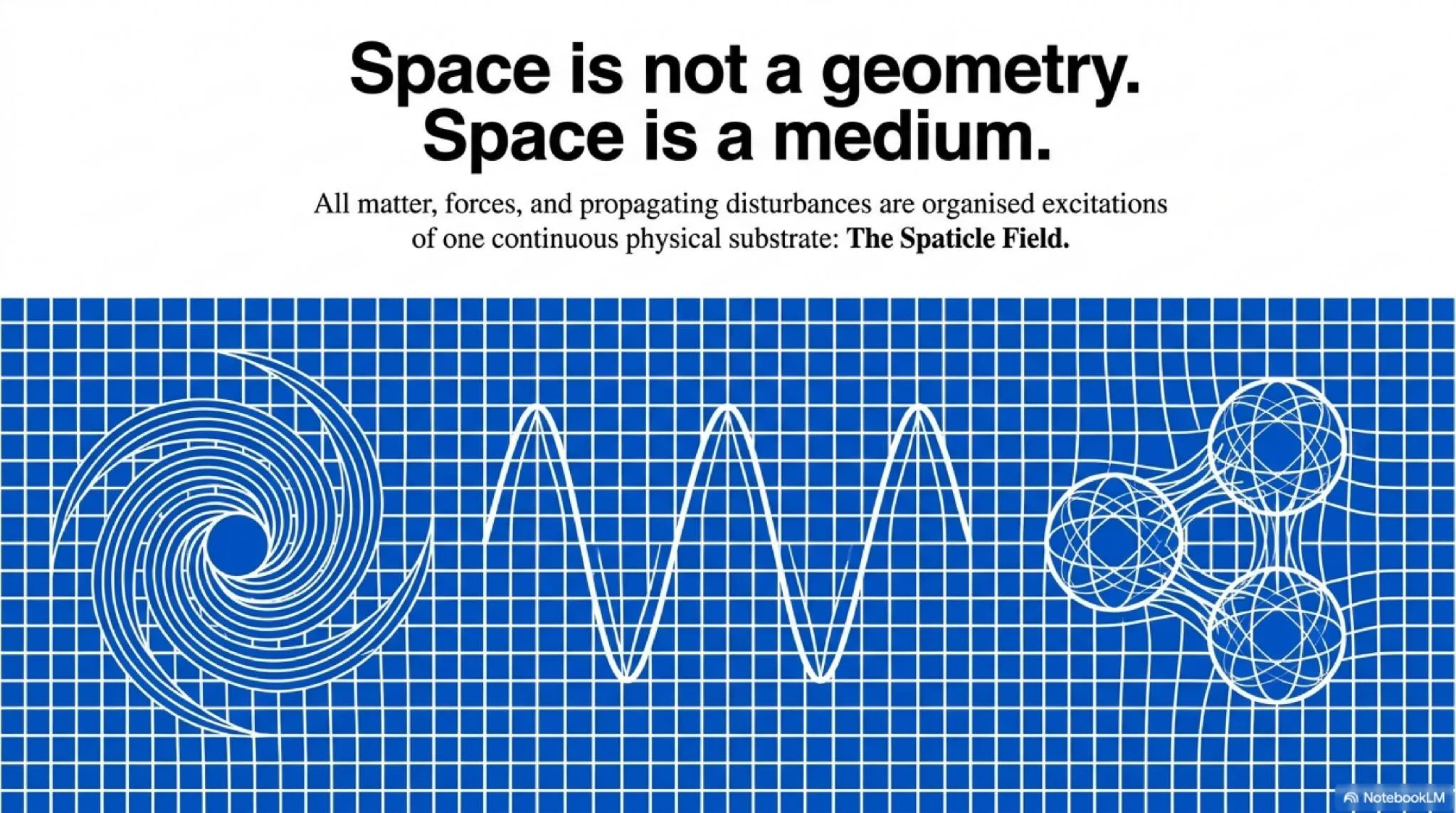
Figure 1. Complete P16 particle-sector derivation chain of the equilibrium Spaticle-field density. The coefficients A, B, C and D determine R₀; ρₛ is obtained only after the particle-sector chain reaches u_g and applies ρₛc² = u_g.
3. Cosmological Uses of the Spaticle-Field Framework
P1 treats the Hubble velocity-distance relationship as an emergent result of gravitational sorting rather than inserting metric expansion as the physical cause; its reported simulation gives a Pearson correlation r = 0.675 and 84% of surviving galaxies receding [P1]. P2 applies the one-substrate ontology to the cosmological-constant and QFT vacuum-energy problem. In the current P16 treatment, the corrected pure-vacuum empty-mode sum is u_QFT,corrected = 0, while the physical substrate has the separate finite rest-energy density uₛ = ρₛc² = 6.56 × 10⁻¹⁰ J/m³. P3 develops steady-state nucleosynthesis and the lithium problem, while P4 examines observer bulk flow as an alternative account of apparent cosmic acceleration [P2-P4].
P5 argues for spatial infinitude and no physical boundary [P5]. P6 treats black holes as gravitational vortices rather than physical infinite-density singularities [P6]. P7 gives the dynamic-thermal-equilibrium interpretation of the 2.725 K CMB temperature, and P8 reconstructs the long cold and dark stage preceding luminous structure [P7, P8]. P9 develops rotation and orbital hierarchy across scales [P9]. P10, P11, P12 and P13 respectively give substrate interpretations of the Sunyaev-Zel'dovich effect, the Lyman-alpha forest and absorption-percolation threshold, the integrated Sachs-Wolfe effect, and weak-lensing S8 results [P10-P13]. P15 separately addresses the state preceding matter and the Spaticle field and the sequence by which the substrate appears in the wider BFUT cosmology [P15].
4. Matter, Antimatter, and Stable Condensation
P16 develops the finite condensation framework from which stable matter structures are built. The condensation functional E(R) = A/R² + BR² + CR + D/R has the interior minimum R₀ = 1.27348221 used in the density chain above. Matter is treated as organised condensation of the Spaticle field rather than as a substance separate from the substrate. P16 also gives the particle-scale relations m_e_vss = mₚ/(6π⁵), ħ_vss = mₚcrₚ/(πR₀), α_vss = e²/(4πε₀ħ_vss c), and the particle-sector closure that yields ρₛ [P16].
P16A extends the construction to antimatter. It treats matter and antimatter as corresponding substrate condensation configurations, explains annihilation through cancellation of opposing organised excitations and release of condensation energy, and develops the stability filter governing which configurations persist. It also develops the antihydrogen comparison framework and the higher four-unit configuration excitations listed in Appendix B, including the Shankar and BFUT resonance assignments [P16A].
5. Fundamental Interactions and Gravitation
P17 derives the programme's stated sequence of gravity, strong, electromagnetic and weak interactions as distinct physical disturbance or organisation channels associated with the Spaticle substrate and the 3+e matter structure. It treats gravity as arising first from substrate deformation associated with condensation, followed by the strong interaction within the bound structure, electromagnetic behaviour from charge/counter-rotation organisation, and the weak interaction in the corresponding transition structure. The same paper subsequently uses these four interactions as the programme's fundamental sensing channels [P17].
P18 formulates gravitation through the covariant carrier-field equation F1-cov, substrate deformation, finite deformation domains and the Dark Matter Effects framework. Its density-derived inverse-length scale is μₛ = √(3Gρₛ/c²) = 4.03359 × 10⁻²⁷ m⁻¹, and the corresponding acceleration scale is aₛ = c²μₛ/3 = c√(Gρₛ/3) = 1.2084 × 10⁻¹⁰ m s⁻². The finite deformation-domain relation is R_d = (3M/8πρₛ)^(1/3). P18 states that F1-cov is the general carrier equation, while the organised galactic and lensing-stack regimes use the DME equation [P18].
6. Galactic Dynamics, Weak Lensing, and Dark-Matter Effects
P18, P25 and P78 apply the substrate-derived gravitational framework to the extra gravitational support conventionally attributed to dark matter. In the organised regime, the DME relation is v²(R) = v_b²(R)[1 + aₛR/v_b²(R)]^(1/2), equivalently g_DME = g_b[1 + aₛ/g_b]^(1/2). The equation uses the baryonic distribution together with the single density-derived scale aₛ rather than introducing a dark-matter particle or a per-galaxy fitted acceleration constant [P18, P25, P78].
The current validation record applies the same density-derived acceleration scale to 175 SPARC galaxies and to KiDS-1000 stacked weak-lensing bins. The cross-sector appendix records the SPARC shape agreement, flat/non-flat classification results and median outer residual, and identifies the KiDS-1000 stacks as a separate weak-lensing test using the same DME relation and density-derived scale. P14 reproduces those source-paper results in Appendix A rather than recalculating them.
7. Particle Physics and Fundamental Constants
P19 takes the P16 condensation geometry into the particle-physics closure programme. Among the source-paper relations reproduced in the current appendices are m_Z_vss = π⁴mₚ = 91.396 GeV/c² and m_W_vss = (256/3)mₚ = 80.066 GeV/c²; their ratio gives the stated on-shell electroweak quantity sin²θ_W_vss = 1 - (m_W_vss/m_Z_vss)² = 0.23257. P19 also gives the strong-coupling expression αₛ_vss = BR₀⁴/(8πA), the H-class radial-mode relation λ_H_vss = 2AR₀/π², and the resulting H-class mass m_H_vss = 124.75 GeV/c² [P19].
P16 and P19 connect the same condensation geometry to the action and electromagnetic scales. P16 gives ħ_vss = 1.05457687 × 10⁻³⁴ J s and α_vss⁻¹ = 137.036655199 within the density chain above. P19 develops the corresponding particle-sector closure and resonance relations. P27 then rewrites standard quantum formulas and Planck-unit expressions using the BFUT action scale; those are downstream uses of the P16 result, not a second independent derivation of ħ [P16, P19, P27].
8. Quantum Mechanics and Quantum-Gravity Interpretation
P19A places quantum phenomena and gravitation within the common substrate framework. Its stated interpretations include half-integer spin through 720-degree restoration topology, the Born rule through substrate deformation-energy density, wave-function collapse as physical state resolution under interaction, and substrate accounts of superposition, entanglement, tunnelling, decoherence, Pauli exclusion, spin-statistics and gauge structures [P19A].
P19A also connects the covariant substrate carrier framework to the Schrödinger equation in the non-relativistic limit, so the standard wave equation is retained while the paper supplies a proposed physical substrate interpretation. P27 expresses Compton and de Broglie wavelengths, harmonic-oscillator levels, uncertainty relations and Planck units using ħ_vss. P24 applies the same substrate/action framework to quantum-computing questions including gate evolution, minimum gate time, substrate memory and quantum-correlation treatments [P19A, P24, P27].
9. Time, Light, Photons, and the Universal Speed Limit
P22 defines time as accumulated substrate evolution and develops special-relativistic and gravitational time dilation through allocation of finite substrate propagation capability. Its propagation-budget framework writes the available capacity in terms of spatial motion, internal evolution and gravitational deformation, and uses that same mechanism to discuss length contraction, the twin paradox, clock universality, the arrow of time, simultaneity and causality [P22].
P23 identifies c as the maximum rate at which the Spaticle substrate can reorganise and propagate a disturbance. It treats electric fields, magnetic fields and photons as bound and free dynamical states of organised electromagnetic excitation in the same substrate, and treats light and gravitational waves as sharing the same limiting propagation speed because both propagate through that substrate [P23]. The mechanical relation c_vss = √(Kₛ/ρₛ) belongs to the source-paper substrate mechanics. Where Kₛ is written as ρₛc², this form is a consistency identity; the separate numerical reconstruction of c is given in the particle/action chain [P19, P23, P27].
10. Atomic Structure and Matter Stability
P25 connects the substrate and particle-sector quantities to hydrogen ground-state structure, the Bohr radius, atomic stability and molecular or chemical stability. The current applications catalogue records these as downstream uses of ħ_vss, m_e_vss, α_vss and the corresponding atomic-energy relations. P16 also distinguishes these quantities from those that depend explicitly on ρₛ: a result is density-dependent only where ρₛ survives in its final displayed equation [P16, P19, P25, P27].
11. Finite-Density Extreme Gravity and Black Holes
P26 argues that finite substrate density, restoring dynamics and finite propagation capacity prevent physical infinite density and provide finite-density bounds for compact collapse [P26]. P28 develops the corresponding black-hole picture as a finite gravitational-vortex structure with a compressed core, surrounding redistribution and entrainment regions, rotational sustenance and a finite deformation domain. P6 supplies the earlier Universal Centrality Rule and gravitational-vortex treatment. P14 records these source-paper mechanisms without adding a new compact-object model [P6, P26, P28].
12. From Fundamental Interactions to Sensing and Consciousness
P17 treats the four fundamental interactions as a hierarchy of physical sensing channels as well as interactions. P20 develops the subsequent sensing-channel framework and its formal conditions for sensing, including the Hierarchical Channel Accessibility model. P21 develops the Consciousness Index as the programme's scalar measure of conscious degree, structure and evolutionary potential. P14 does not derive consciousness from the density equation; it only records the source papers' stated conceptual chain from physical substrate and interactions to sensing channels and then to the P20-P21 consciousness framework [P17, P20, P21].
P14 therefore stops at synthesis: it records the programme's stated chain from substrate to matter, from matter to interactions, from interactions to sensing channels, and from sensing channels to the consciousness framework. The definitions, derivations, and claims at each stage remain those of the cited source papers.
13. Conclusion
The Spaticle field is therefore not established by a single claim in P14 but by the roles assigned to it across the BFUT source papers. P16 supplies the complete particle-sector density derivation; P16A develops antimatter and the stability filter; P17 and P18 develop interactions, carrier gravitation, finite domains and DME; P19 and P19A develop particle closure and quantum interpretation; P22 and P23 develop time and propagation; P25-P28 and P78 apply the same framework to atomic structure, galaxy dynamics, weak lensing, the action scale, finite-density collapse and black holes; the cosmological papers apply the substrate ontology to their respective large-scale phenomena; and P20-P21 develop the sensing-channel and consciousness framework. The two appendices that follow reproduce the programme's current cross-sector validation and 106-item applications catalogue. No additional physical result is asserted in this synthesis.
Appendix A
Cross-Sector Validation of the Spaticle Field & Its Density
The Big Flare-Up Theory (BFUT) framework identifies the Spaticle Field as the physical substrate underlying the phenomena addressed across the programme. Its intrinsic equilibrium density is ρₛ = 7.3 × 10⁻²⁷ kg/m³ derived from the free energy condensation functional.
The following sector-wise table brings together the physical domains in which the Spaticle Field, its density, and quantities derived from it provide relationships, quantitative results, or observational validation.
| S. No. | Physical sector | Spaticle Field quantities used or derived | Validation / physical result | BFUT papers |
|---|---|---|---|---|
| 1 | Cosmology and large-scale structure | ρₛ; substrate energy density uₛ = ρₛc²; gravitational domain scale derived from ρₛ | Cosmological vacuum-energy relationship; finite substrate gravitational domain; large-scale structure and related cosmological consequences addressed through the BFUT substrate framework. | P14, P18, P23, P25, P26, P27 |
| 2 | Gravitation and gravitational field | ρₛ; carrier mass scale μₛ; Lₛ; acceleration scale aₛ; substrate deformation | Covariant carrier equation, finite deformation-domain radius, dark matter effects equation (DME) gravitational response, and a unified gravitational description across quantum, classical, galactic, and rapid-transition regimes. | P17, P18, P25, P26 |
| 3 | Galactic dynamics and dark-matter effects | ρₛ; aₛ = 1.208 × 10⁻¹⁰ m/s²; DME equation; DDR domain | SPARC validation across 175 galaxies: 92.0% shape agreement, 98.8% flat classification, 14.3% non-flat classification, and median outer relative residual 0.096. DME accounts for the observed extra gravitational support without introducing a dark-matter particle. | P18, P25, P26, P78 |
| 4 | Weak gravitational lensing | ρₛ; aₛ; DME domain response | KiDS-1000 validation using the same DME relation and the same density-derived acceleration scale. The four stacked stellar-mass bins provide an independent weak-lensing test of the gravitational response. | P18, P25, P27, P78 |
| 5 | Particle physics and fundamental constants | R₀; ħ_vss; m_e_vss; α_vss; αₛ_vss; M; m_W_vss; m_Z_vss; sin²θ_W_vss; λ_H_vss; v_vss; m_H_vss; m_Shankar; m_BFUT | The P16 condensation geometry supplies the common particle-sector origin. P19 gives the independent resonances m_Z_vss = π⁴mₚ = 91.396 GeV/c² and m_W_vss = 256M = (256/3)mₚ = 80.066 GeV/c²; their ratio gives sin²θ_W_vss = 0.23257. The radial mode gives λ_H_vss = 2AR₀/π² and m_H_vss = 124.75 GeV/c². P16A gives the higher four-unit configuration excitations m_Shankar c² = 776.5 MeV (2+2) and m_BFUT c² = 1403.7 MeV (4+0). | P16, P16A, P17, P19, P19A, P25, P27 |
| 6 | Quantum mechanics | ρₛ; condensation structure; ℏ; particle mass relations | BFUT P19A connects the substrate-based particle structure with quantum phenomena including half-integer spin, the Born rule, wave-function collapse, and Higgs physics, within the unified quantum-gravity framework. | P16, P19A, P25, P27 |
| 7 | Atomic physics and matter stability | ρₛ; ħ_vss; m_e_vss; α_vss; a₀_vss; E_H_vss | Hydrogen ground-state and Bohr-radius results follow from ħ_vss, m_e_vss and α_vss. Matter stability follows from the corresponding atomic-scale and bond-energy relations. | P16, P19, P25, P27 |
| 8 | Light, photons, and gravitational-wave propagation | ρₛ; substrate stiffness Kₛ; c | Photon and gravitational-wave propagation arise from the same substrate propagation mechanism. The universal speed limit is written mechanically as c_vss = √(Kₛ/ρₛ), with an independent numerical reconstruction of c_vss from the BFUT quantity chain. | P17, P18, P19, P23, P25 |
| 9 | Time and relativity | ρₛ; c; substrate propagation efficiency η; carrier response structure | Time is treated as accumulated substrate evolution. Kinematic and gravitational time dilation arise from the allocation of finite substrate propagation capability between spatial motion, internal evolution, and gravitational deformation. | P18, P19, P22, P23 |
| 10 | Extreme gravity, singularity limits, and black holes | ρₛ; substrate deformation and finite-density dynamics; gravitational-vortex structure | Physical substrate dynamics impose a finite-density causal bound and remove the need to interpret infinite density as a physical state. Black holes are treated as gravitational vortices, with the Universal Centrality Rule providing an observational structural test. | P6, P26, P28 |
Appendix B
Applications and Derived Results of the Spaticle Field
This appendix lists independently meaningful physical applications, derived results, predictions, and observational applications that have a direct derivational or physical chain to the Spaticle Field or its derived density. Intermediate mathematical calculations are not listed as separate applications.
| SN | Application / Derived Result | Physical result or BFUT application | BFUT source |
|---|---|---|---|
| 1 | Spaticle-field equilibrium density | Intrinsic substrate density ρₛ = 7.3 × 10⁻²⁷ kg/m³, obtained from the condensation framework and used as the common physical substrate parameter. | P16; P25; P78 |
| 2 | Matter creation from the Spaticle Field | Matter condenses from the physical Spaticle Field and remains embedded in it. This provides the substrate basis for the particle and matter structures developed throughout BFUT. | P14; P16; P17 |
| 3 | Propagation of forces and physical disturbances through the Spaticle Field | Forces and physical disturbances propagate through the Spaticle Field. This supplies the common physical carrier underlying the electromagnetic, gravitational, weak, and strong interaction descriptions. | P14; P17; P18; P23 |
| 4 | Stable condensation equilibrium | The condensation functional produces a finite non-zero equilibrium condensation scale R₀ for stable matter structures. | P16 |
| 5 | Proton condensation structure | The three-core condensation architecture produces the structural basis for proton formation. | P16 |
| 6 | 3+e proton structure | The stable 3+e organisation supplies the particle architecture used in the proton and electron formation chain. | P16; P17 |
| 7 | Electron mass | The BFUT particle chain derives electron mass from the proton-scale condensation construction. | P16; P19 |
| 8 | Matter-antimatter structure and annihilation | Matter and antimatter are treated as corresponding substrate condensation configurations, with annihilation arising from cancellation of opposing organised excitations and release of condensation energy. | P16; P16A |
| 9 | Antihydrogen structure and CERN comparison | The BFUT antimatter construction gives a mirror configuration for antihydrogen and provides a framework for comparison with CERN antihydrogen measurements. | P16A |
| 10 | Stability filter for matter and antimatter | The stability filter identifies which condensation configurations can persist as stable matter or antimatter structures. | P16; P16A |
| 11 | Emergence of the fundamental forces | Gravity, strong, electromagnetic, and weak interactions are derived as distinct physical disturbance or organisation channels associated with the substrate and 3+e matter structure. | P17 |
| 12 | Gravity as substrate deformation and restoring response | Gravitational attraction is described as the restoring response of the Spaticle Field to matter-induced deformation. | P17; P18 |
| 13 | Covariant carrier-field equation | F1-cov provides the covariant substrate equation governing gravitational deformation and propagation. | P18 |
| 14 | Density-derived carrier scale | The substrate density fixes the carrier scale μₛ and its associated propagation/screening scales. | P18 |
| 15 | Finite gravitational deformation domain | For source mass M, BFUT gives a finite deformation-domain radius R_d = [3M/(8πρₛ)]^(1/3). | P18; P22; P26 |
| 16 | Rotationally enlarged deformation domain | The effective deformation domain incorporates the rotational correction defined by the BFUT carrier model. | P18 |
| 17 | Carrier relaxation length and timescale | The carrier framework supplies finite response and relaxation scales for substrate deformation. | P18; P26 |
| 18 | Cosmological screening length | The density-derived carrier mass establishes a finite cosmological screening scale for the static carrier field. | P18 |
| 19 | BFUT gravitational acceleration scale | The characteristic acceleration aₛ is derived from the substrate density, G, and c. | P18; P78 |
| 20 | Finite-domain gravity across physical regimes | The finite deformation-domain carrier is formulated for quantum, classical, galactic, and rapid-transition regimes, providing a common and testable gravitational description across those scales. | P18 |
| 21 | Dark Matter Effects interpretation | The gravitational effect conventionally attributed to dark matter is represented in BFUT by organised or entrained Spaticle-field structure. | P18; P25; P78 |
| 22 | Dark Matter Effects equation | The DME relation derives the additional rotational contribution from the baryonic distribution and the substrate-derived acceleration scale without modifying Newtonian gravity. | P18; P25; P78 |
| 23 | SPARC rotation-curve validation | DME is applied to the 175-galaxy SPARC sample using the same substrate-derived acceleration scale and published baryonic inputs. | P25; P78 |
| 24 | KiDS-1000 weak-lensing validation | DME is applied to the KiDS-1000 stacked weak-lensing mass bins using the same substrate-derived acceleration scale. | P25; P78 |
| 25 | Additional galaxy-system tests | DME is tested against additional named systems, including low-dark-matter and ultra-diffuse systems in the observational programme. | P25; P78 |
| 26 | Merger morphology and substrate entrainment | Merger systems are interpreted through the redistribution and entrainment of substrate-associated mass during interaction. | P78 |
| 27 | Low-rotation systems | Systems with negligible organised rotation provide a regime in which the substrate contribution predicted by the rotational DME mechanism is correspondingly reduced. | P25; P78 |
| 28 | Sunyaev-Zel'dovich effect | P10 gives a Spaticle-field interpretation of the SZ effect through interaction of propagating substrate modes with the thermal electron population. | P10; P25 |
| 29 | Lyman-alpha forest | P11 interprets the Lyman-alpha absorption forest through the interaction of propagating structures with the substrate and the absorption-percolation threshold. | P11; P25 |
| 30 | Integrated Sachs-Wolfe effect | P12 attributes the ISW temperature contribution to variations in Spaticle-field density encountered by photons along their path. | P12; P25 |
| 31 | Weak-lensing S8 application | P13 connects the weak-lensing S8 result and suppressed late-time structure growth to the physical substrate and its domain dynamics. | P13; P25 |
| 32 | CMB acoustic peaks | The BFUT cosmological substrate framework models acoustic structure through ongoing shell processes in the physical substrate and reproduces CMB-like peak structure in the reported proof-of-principle treatment. | P12; P25 |
| 33 | BAO-like feature | The same cosmological substrate treatment produces a BAO-like feature in the reported proof-of-principle simulation. | P12; P25 |
| 34 | Fine-structure constant | The fine-structure constant α_vss is derived from the BFUT condensation and electromagnetic circulation structure. | P19; P27 |
| 35 | Strong coupling constant | The strong coupling αₛ_vss is derived from the P16 condensation parameters and evaluated at the Z-boson mass scale. | P19 |
| 36 | Weak mixing angle | The BFUT electroweak mixing quantity is read from the independently derived resonance masses: sin²θ_W_vss = 1 − (m_W_vss/m_Z_vss)² = 0.23257. | P19 |
| 37 | W-boson mass | The charged W resonance is the n=4 coherent reconfiguration: m_W_vss = 256M = (256/3)mₚ = 80.066 GeV/c². No mixing angle enters this mass relation. | P19; P25 |
| 38 | Z-boson mass | The neutral Z core-stay resonance follows from the proton-scale condensation chain: m_Z_vss = π⁴mₚ = 91.396 GeV/c². No mixing angle enters this mass relation. | P19; P25 |
| 39 | H-class radial resonance mass | The radial H resonance follows from λ_H_vss = 2AR₀/π² and v_vss = 6E_unit/α_vss: m_H_vss = v_vss√(2λ_H_vss) = 124.75 GeV/c². | P19 |
| 40 | H-class state as a radial resonance | The observed H-class state is a radial resonance of the one Spaticle field; BFUT introduces no separate Higgs field. | P19A |
| 41 | Shankar and BFUT configuration resonances | P16A derives the 2+2 Shankar resonance at m_Shankar c² = 776.5 MeV and the 4+0 BFUT resonance at m_BFUT c² = 1403.7 MeV from the four-unit configuration gaps and E_unit. | P16A |
| 42 | Quark-mass hierarchy | The particle programme derives the quark-mass hierarchy from the condensation and circulation architecture. | P19; P19A |
| 43 | Hydrogen Bohr radius | BFUT-derived particle and action quantities are used in the atomic relation for the hydrogen ground-state radius. | P16; P25 |
| 44 | Hydrogen ground-state binding energy | The BFUT atomic construction gives the hydrogen ground-state binding energy. | P16; P25 |
| 45 | Atomic stability | The finite condensation structure and substrate density are connected to the persistence of atomic structure. | P25 |
| 46 | Molecular and chemical stability | P25 derives sensitivity of atomic and molecular structure to the substrate density, including a density threshold associated with disruption of chemical bonding. | P25 |
| 47 | Electron reference length | The electron reference length is an independently meaningful electromagnetic length scale used in the BFUT particle-sector construction and connected to the substrate-derived particle parameters. | P19; P78 |
| 48 | Reduced Planck constant | The reduced Planck constant is derived from proton mass, proton charge radius, c, and the condensation minimum R₀: ħ_vss = mₚ c rₚ/(πR₀). | P16; P27 |
| 49 | Planck constant | Planck's constant follows as h_vss = 2πħ_vss and supplies the action quantum used in BFUT quantum relations. | P16; P27 |
| 50 | Minimum circulation quantum | The minimum angular-momentum scale ħ_vss/2 is connected to the 720° restoration topology of the matter condensation. | P19A; P27 |
| 51 | Compton wavelength | The Compton wavelength is expressed using the BFUT action scale and particle parameters. | P27 |
| 52 | de Broglie wavelength | The de Broglie wavelength is expressed using the BFUT action scale and particle momentum. | P27 |
| 53 | Harmonic-oscillator energy levels | The harmonic-oscillator spectrum is expressed using the ħ_vss and the corresponding quantum action scale. | P27 |
| 54 | Planck length | The Planck length is derived from ħ_vss together with G and c. | P27 |
| 55 | Planck mass | The Planck mass is derived from ħ_vss together with G and c. | P27 |
| 56 | Planck time | The Planck time is derived from ħ_vss together with G and c. | P27 |
| 57 | Vacuum energy density | The equilibrium substrate rest-energy density is u_vac = ρₛc². | P25; P27 |
| 58 | Schrödinger equation | The time-dependent Schrödinger equation is derived as the non-relativistic limit of the covariant substrate carrier equation. | P19A; P27 |
| 59 | Born rule | The Born probability P(x)=|ψ(x)|² is given a physical substrate interpretation through deformation-energy density and measurement interaction. | P19A |
| 60 | Heisenberg uncertainty principle | The uncertainty scale is connected to the finite localisation and action scale of substrate condensations. | P19A; P27 |
| 61 | Half-integer spin | Half-integer spin is derived from the 720° restoration topology of the matter condensation. | P19A; P27 |
| 62 | Spin-statistics relation | The distinction between embedded matter condensations and propagating substrate disturbances supplies the BFUT physical interpretation of fermionic and bosonic statistics. | P19A; P27 |
| 63 | Pauli exclusion principle | Pauli exclusion is explained through the impossibility of identical fermionic condensations occupying one complete circulation state. | P19A; P27 |
| 64 | Fermionic mass hierarchy | Fermionic mass structure is connected to organised circulation within the condensation architecture. | P19A |
| 65 | Gauge symmetry | U(1), SU(2), and SU(3) gauge structures are interpreted through local circulation invariance of substrate condensations. | P19A |
| 66 | Quantum superposition | Superposition is given a physical substrate interpretation as distributed organised excitation before interaction resolves the state. | P19A |
| 67 | Wave-function collapse | Wave-function collapse is interpreted as physical state resolution produced by interaction with matter in the substrate. | P19A |
| 68 | Entanglement | Entanglement is interpreted through shared coherent substrate structure and correlated physical states. | P19A |
| 69 | Quantum tunnelling | Tunnelling is represented through substrate condensation-boundary penetration, with the penetration scale determined by the BFUT action and barrier parameters. | P19A; P27 |
| 70 | Decoherence | Decoherence is interpreted as loss of coherent substrate organisation through environmental interaction. | P19A |
| 71 | Quantum measurement | Measurement is treated as physical interaction between a quantum excitation and detector matter, providing the mechanism for state resolution. | P19A |
| 72 | Quantum gravity unification | Quantum behaviour and gravitation are placed within one substrate framework through the common carrier field and physical substrate. | P18; P19A |
| 73 | Quantum gate evolution | Quantum-gate unitary evolution is expressed using the BFUT-derived action scale, linking phase accumulation to substrate action. | P24; P27 |
| 74 | Quantum-gate minimum time | The minimum controlled gate time is connected to the BFUT action scale and control-field energy. | P24; P27 |
| 75 | Quantum-computing substrate memory | The P24 substrate-memory timescale is connected to the same substrate density that fixes the BFUT action scale. | P24; P27 |
| 76 | Bell correlation | The Bell correlation function is connected to the Born rule and BFUT spin topology in the quantum-computing treatment. | P24 |
| 77 | CHSH quantum bound | The BFUT quantum-computing treatment incorporates the quantum CHSH bound within its substrate interpretation of quantum correlations. | P24 |
| 78 | Time as accumulated substrate evolution | Time is defined as accumulated evolution of physical states in the Spaticle substrate. | P22 |
| 79 | Special-relativistic time dilation | Kinematic time dilation is derived from the finite propagation budget shared between spatial motion and internal evolution. | P22 |
| 80 | Gravitational time dilation | Gravitational time dilation is derived from reduced local substrate propagation efficiency caused by gravitational deformation. | P22 |
| 81 | Unified time-dilation relation | Kinematic and gravitational effects are combined through the common propagation-budget framework. | P22 |
| 82 | Length contraction | Length contraction is derived as a second consequence of the same propagation-budget constraint. | P22 |
| 83 | Twin paradox | The twin paradox is resolved through the different substrate propagation histories of the two clocks. | P22 |
| 84 | Clock universality | All physical clocks slow by the same factor because physical clocks are substrate processes subject to the same propagation budget. | P22 |
| 85 | Photon proper time | A photon assigns its full propagation budget to spatial propagation, giving zero proper time in the BFUT formulation. | P22; P23 |
| 86 | Arrow of time | The direction of time is linked to irreversible outward substrate propagation and accumulated state change. | P22 |
| 87 | Simultaneity and causality | Finite substrate propagation speed supplies the physical basis for causal ordering and simultaneity relations. | P22; P23 |
| 88 | Past and future asymmetry | The substrate evolution framework provides a physical account of the distinction between completed and not-yet-completed state evolution. | P22 |
| 89 | Quantum time evolution | Quantum time evolution is placed within the same physical substrate evolution that defines time macroscopically. | P22; P19A |
| 90 | Equivalence principles | The weak, Einstein, and strong equivalence principles are examined within the BFUT substrate framework. | P22 |
| 91 | Temporal singularity limit | Finite substrate propagation capacity supplies a temporal argument against physically reaching an infinite-density singularity. | P22; P26 |
| 92 | Universal speed limit | c is identified as the maximum rate at which the Spaticle substrate can reorganise and propagate a disturbance. | P23 |
| 93 | Speed of light from substrate stiffness and density | The propagation speed is derived as c_vss = √(K_s/ρₛ). | P23 |
| 94 | Independent reconstruction of c | The speed of light is reconstructed as c_vss, as a consistency relation of the ħ identity, from e, R₀, ε₀, mₚ, rₚ, and α_vss. | P19; P23; P27 |
| 95 | Massive-particle velocity deficit | A massive condensation devotes part of its physical energy budget to internal structure, leaving less capacity for spatial propagation. | P23 |
| 96 | Equality of light and gravitational-wave speeds | Light and gravitational waves are disturbances of the same substrate and therefore share the same limiting propagation speed. | P23 |
| 97 | Singularity impossibility | Finite substrate density and restoring dynamics prevent physical infinite density. | P26 |
| 98 | Finite-density causal bound | The causal bound ρ̄_max = 3c⁶/(4πG³M²) gives a finite mean-density limit for compact collapse. | P26 |
| 99 | Finite gravitational compression | The substrate restoring mechanisms oppose unlimited gravitational compression. | P26; P28 |
| 100 | Black holes as finite gravitational vortices | Black holes are represented as finite-density gravitational vortex structures without a physical infinite-density singularity. | P6; P26; P28 |
| 101 | Black-hole finite core and surrounding structure | The BFUT black-hole model specifies a finite compressed core together with surrounding redistribution, coherence, and entrainment regions. | P28 |
| 102 | Black-hole redistribution and entrainment | Organised deformation is redistributed from the compressed core into the surrounding shell and deformation domain. | P28 |
| 103 | Black-hole deformation domain | The finite deformation-domain relation defines the outer extent of organised substrate deformation around a compact mass. | P18; P26; P28 |
| 104 | Rotational sustenance of gravitational structure | Sustained rotation is treated as the dynamical condition supporting organised gravitational-vortex structure and continued compression. | P26; P28 |
| 105 | Black-hole seed dissipation | The substrate relaxation framework supplies a characteristic dissipation timescale for transient deformation. | P26 |
| 106 | Hawking-radiation interpretation | Within the finite-substrate black-hole structure, BFUT argues that Hawking radiation has no physical realisation. | P28 |
References
[P1] Sharma, V. S. (2026). Gravitational Sorting as an Alternative Mechanism for the Hubble Relationship. BFUT Paper 1. Zenodo. DOI: 10.5281/zenodo.19226423
[P2] Sharma, V. S. (2026). The Physical Identity of the Cosmological Constant. BFUT Paper 2. Zenodo. DOI: 10.5281/zenodo.19242083
[P3] Sharma, V. S. (2026). A Steady-State Nucleosynthesis Resolution of the Cosmological Lithium Problem. BFUT Paper 3. Zenodo. DOI: 10.5281/zenodo.19205920
[P4] Sharma, V. S. (2026). Observer Bulk Flow as an Alternative Explanation for Apparent Cosmic Acceleration. BFUT Paper 4. Zenodo. DOI: 10.5281/zenodo.19228065
[P5] Sharma, V. S. (2026). The Universe Has No Boundary: Logical, Derivational, and Observational Arguments for Spatial Infinitude. BFUT Paper 5. Zenodo. DOI: 10.5281/zenodo.19242759
[P6] Sharma, V. S. (2026). Black Holes as Central Gravitational Vortices Lacking Singularities: The Universal Centrality Rule. BFUT Paper 6. Zenodo. DOI: 10.5281/zenodo.19300874
[P7] Sharma, V. S. (2026). Dynamic Thermal Equilibrium as an Alternative Origin for the CMB Temperature. BFUT Paper 7. Zenodo. DOI: 10.5281/zenodo.19302025
[P8] Sharma, V. S. (2026). Cold, Dark, and Inevitable: A Logical Reconstruction of the Universe Before the Big Flare-Up. BFUT Paper 8. Zenodo. DOI: 10.5281/zenodo.19323579
[P9] Sharma, V. S. (2026). Cosmic Rotation Across Scales, Emergent Orbital Hierarchy, and the Large-Scale Challenge to Metric Expansion. BFUT Paper 9. Zenodo. DOI: 10.5281/zenodo.19341549
[P10] Sharma, V. S. (2026). The Sunyaev-Zel'dovich Effect as Local Substrate Interaction: A Big Flare-Up Theory Reinterpretation. BFUT Paper 10. Zenodo. DOI: 10.5281/zenodo.19377396
[P11] Sharma, V. S. (2026). The Lyman-Alpha Forest in the Big Flare-Up Theory: Absorption Percolation Threshold. BFUT Paper 11. Zenodo. DOI: 10.5281/zenodo.19383804
[P12] Sharma, V. S. (2026). The Integrated Sachs-Wolfe Effect in BFUT: Local Spaticle Field Temperature Variations as an Alternative Origin. BFUT Paper 12. Zenodo. DOI: 10.5281/zenodo.19391470
[P13] Sharma, V. S. (2026). Weak Gravitational Lensing and the S8 Tension in BFUT: Why Late-Time Clustering Inference Is Not a Unique Test of Lambda-CDM. BFUT Paper 13. Zenodo. DOI: 10.5281/zenodo.19392597
[P15] Sharma, V. S. (2026). What Existed Before Matter and the Spaticle Field: The Origin of Space, Time, and the Physical Substrate of Reality in an Infinite Universe. BFUT Paper 15. Zenodo. DOI: 10.5281/zenodo.19811691
[P16] Sharma, V. S. (2026). The Origin of Matter, Antimatter, and Fundamental Forces: How Protons, Electrons, and Hydrogen Formed. BFUT Paper 16. Zenodo. DOI: 10.5281/zenodo.19908215
[P16A] Sharma, V. S. (2026). Antimatter, Annihilation, and the Stability Filter: Predictions for the CERN Antihydrogen Programme. BFUT Paper 16A. Zenodo. DOI: 10.5281/zenodo.20201014
[P17] Sharma, V. S. (2026). The Emergence of Forces and Fundamental Senses: How the Spaticle Field Gave Rise to Gravity and All Other Forces. BFUT Paper 17. Zenodo. DOI: 10.5281/zenodo.19976408
[P18] Sharma, V. S. (2026). Beyond General Relativity: A Unified Gravitation Equation Across Quantum, Classical, Galactic, and Rapid-Transition Regimes. BFUT Paper 18. Zenodo. DOI: 10.5281/zenodo.20145506
[P19] Sharma, V. S. (2026). Unification of Particle Physics: Deriving Fine Structure and Coupling Constants, W, Z, and Higgs Boson Masses, Redefining and Unifying Gravity and Time. BFUT Paper 19. Zenodo. DOI: 10.5281/zenodo.20145567
[P19A] Sharma, V. S. (2026). Unifying Quantum Mechanics with Gravity, Demystifying Twenty Quantum Phenomena Including Half-Integer Spin, the Born Rule, Wave Function Collapse, and Higgs Physics. BFUT Paper 19A. Zenodo. DOI: 10.5281/zenodo.20145695
[P20] Sharma, V. S. (2026). From Matter and Fundamental Forces to Consciousness: A Unified Framework of Sensing Channels, Control, and Evolution. BFUT Paper 20. Zenodo. DOI: 10.5281/zenodo.19992457
[P21] Sharma, V. S. (2026). The Consciousness Index (CI): A Physically Grounded Scalar Measure of Conscious Degree, Structure, and Evolutionary Potential. BFUT Paper 21. Zenodo. DOI: 10.5281/zenodo.20025739
[P22] Sharma, V. S. (2026). Time: Identifying the Cause and Effects and Unifying General and Special Relativity. BFUT Paper 22. Zenodo. DOI: 10.5281/zenodo.20556908
[P23] Sharma, V. S. (2026). Light, Photons, and the Universal Speed Limit: A First-Principles Derivation of c from Substrate Condensation Dynamics. BFUT Paper 23. Zenodo. DOI: 10.5281/zenodo.20577935
[P24] Sharma, V. S. (2026). Quantum Computing and the Missing Physics Causing Delays and Overspend: Real Unknown Unknowns Identified Through the BFUT Substrate Framework. BFUT Paper 24. Zenodo. DOI: 10.5281/zenodo.20620192. Access to the full derivations and experimental proposals in this paper is restricted by the author.
[P25] Sharma, V. S. (2026). Dark Matter: Connecting Galaxy Clusters, Galaxy Rotations, the Cosmological Constant, W and Z Boson Masses, and Atomic Structure Through One Physical Constant. BFUT Paper 25. Zenodo. DOI: 10.5281/zenodo.20535295
[P26] Sharma, V. S. (2026). Singularity: Why and How Physical Substrate Dynamics Make Infinite Density Impossible. BFUT Paper 26. Zenodo. DOI: 10.5281/zenodo.20557070
[P27] Sharma, V. S. (2026). The Planck Constant: A First-Principles Derivation of ħ and How It Reshapes the Interpretation of Quantum Mechanics. BFUT Paper 27. Zenodo. DOI: 10.5281/zenodo.20620283
[P78] Sharma, V. S. (2026). Extra Gravity in SPARC and KiDS-1000 Without a Dark-Matter Particle or Changing Newtonian Gravity: The Connection to Electron Mass and the Fine-Structure Constant. BFUT Paper 78. Zenodo. DOI: 10.5281/zenodo.22696262
[P28] Sharma, V. S. (2026). Black Holes Demystified: What They Actually Are, the Universal Centrality Rule, Why Singularities Cannot Form, and Why Hawking Radiation Doesn't Exist. BFUT Paper 28. Zenodo. DOI: 10.5281/zenodo.20740461